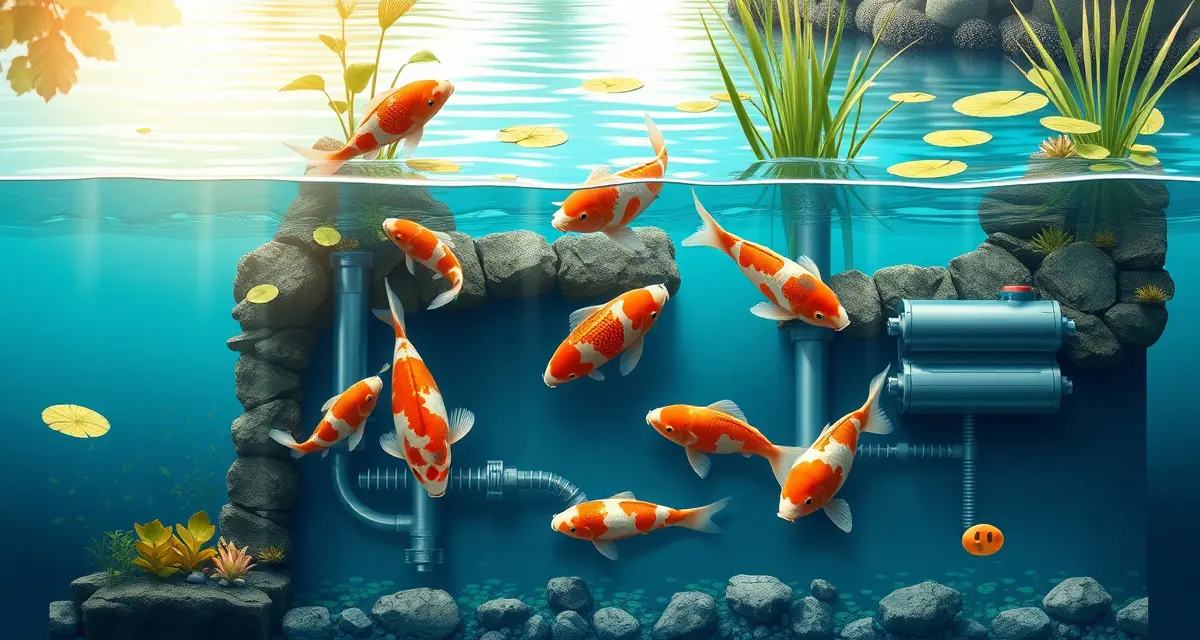
Managing Organic Load in Koi Ponds: Feeding and Waste Control
Overfeeding is responsible for 30-40% of established koi pond koi pond water quality tracker problems. This proportion is high enough to make feeding management the first thing to review when water quality deteriorates in an established pond - before changing equipment, adjusting chemicals, or investigating disease. A koi pond's organic load is dominated by food input, and overfeeding is endemic among koi keepers who associate feeding with fish care.
KoiQuanta's feeding logs correlate with parameter readings to identify organic load patterns. No competitor links feeding records to organic load and water quality in this way.
TL;DR
- The 5-minute observation approach adjusts to actual consumption.
- A premium food that produces 30% less ammonia per kilogram fed is not just a quality-of-life improvement - it directly reduces organic load for the same feeding quantity.
- Keepers who analyse their feeding-parameter data typically reduce feeding by 20-30% and see immediate water quality improvement.
- Early detection based on parameter trends reduces treatment costs and fish stress.
- Seasonal changes require adjusted monitoring schedules; automated reminders help maintain consistency.
What Organic Load Is and Why It Matters
Organic load is the total quantity of organic matter entering and accumulating in your pond system. Sources include:
Fish food: The primary and most controllable source. All food introduced to the pond, whether consumed or not, enters the organic load.
Fish waste: Koi excrete nitrogen as ammonia directly through their gills, plus solid waste (faeces) containing undigested organic matter.
Decomposing plant material: Dead leaves, dying algae, submerged plant detritus all add organic matter.
Wildlife input: Insects, leaves, pollen, bird droppings, and other external organic inputs.
Uneaten food: The highest-concentration organic input. Undigested pellets decompose rapidly in pond water, releasing concentrated organic compounds.
Why organic load matters:
Ammonia production: All organic nitrogen eventually becomes ammonia through bacterial decomposition. More organic load = more ammonia pressure on the biological filter.
Nitrate accumulation: Even if the biological filter handles ammonia effectively, the end product (nitrate) accumulates. High nitrate feeds algae and degrades water quality.
Dissolved organic carbon (DOC): Decomposing organic matter releases dissolved organic compounds that create biological oxygen demand (BOD), consume oxygen, and fuel bacterial growth.
Parasite substrate: Many parasites thrive in high-organic environments. Elevated organic load is associated with higher parasite pressure.
Water clarity: Dissolved and suspended organic matter reduces clarity.
Feeding Management: The Primary Control
The 5-Minute Rule
The most widely used feeding guideline for koi: feed only what fish consume within 5 minutes, then remove any uneaten food.
This rule exists because koi feeding behaviour changes with temperature, time of day, fish health, and season. A fixed quantity fed regardless of conditions will routinely overfeed in some conditions and underfeed in others. The 5-minute observation approach adjusts to actual consumption.
How to apply it:
- Add a small amount of food - less than you think they'll eat
- Observe for 5 minutes
- If all food is consumed quickly, add another small amount
- Stop when consumption slows significantly
- Net out any uneaten food remaining after 5 minutes
This takes more time than tossing a handful of pellets from a distance and walking away. The water quality benefit is significant.
Feeding Frequency and Temperature
Koi metabolic rate is temperature-dependent. At higher temperatures, they can digest more food more quickly; at lower temperatures, digestion slows significantly.
Temperature-based feeding guidelines:
| Water Temperature | Feeding Frequency | Food Type |
|---|---|---|
| Below 8°C | Stop feeding | - |
| 8-10°C | Once every 2-3 days maximum | Wheat germ only |
| 10-15°C | Once daily | Wheat germ or low-protein |
| 15-20°C | Twice daily | Standard growth food |
| 20-28°C | 3-4 times daily | High-protein food |
| Above 28°C | Once daily, reduced quantity | High-quality protein |
At high summer temperatures (above 28°C), reduce feeding because warm water holds less dissolved oxygen and high protein food processing increases oxygen demand.
Food Quality Matters
Higher digestibility food produces less waste per unit of protein delivered to the fish. Food with better amino acid profiles is utilised more efficiently, producing less ammonia per gram fed.
This is a real and measurable difference between budget and premium koi food. A premium food that produces 30% less ammonia per kilogram fed is not just a quality-of-life improvement - it directly reduces organic load for the same feeding quantity.
Store food correctly. Dry storage in a cool, dry place. Use within the shelf life - oxidised fats in old food produce free radicals that harm fish health and reduce digestibility, increasing organic waste per unit fed.
Mechanical Filtration and Waste Removal
Mechanical filtration removes solid waste from the water column before it decomposes. This is the direct organic load reduction measure after feeding management.
Bottom drains: The most effective mechanical waste removal system. A bottom drain located at the lowest point of the pond draws the heaviest solid waste to a settlement chamber, from which it can be purged. Bottom drain design is the gold standard for Japanese-style koi ponds and dramatically reduces organic accumulation on the pond floor.
Vortex/settlement chambers: A first-stage chamber in the filter run where reduced water velocity allows heavy solid waste to settle and be removed by draining.
Drum filters: Automated mechanical filters that capture suspended solids on a rotating mesh drum, then backwash the solids out of the system. Effective but expensive. Standard in high-end koi systems.
Pond vacuums: Manual removal of accumulated waste from the pond floor. Effective but labour-intensive. Most useful in ponds without bottom drains.
Surface skimmers: Capture floating organic debris before it sinks and decomposes. Particularly valuable in ponds near trees or with heavy feeding.
Pond Design for Organic Load Control
Some organic load management is built into the pond's design rather than the management system:
Smooth pond floor: A smooth, simple floor with no substrate allows waste to accumulate in a few low points where it can be removed. Complex substrate, rocks, and gravel create traps where waste accumulates and can't be effectively removed.
Bottom slope to drain: A pond floor that slopes toward the bottom drain brings waste to where it can be efficiently removed.
Strategic planting: Aquatic plants consume nutrients (nitrogen, phosphorus) from the water, reducing organic load. However, dying plant material adds to the organic load. Live, actively growing plants are a net benefit; dead and dying plants are a net liability.
Pond depth: Deeper ponds have more water volume relative to the organic load from a given fish population, diluting the effect.
How Does Overfeeding Affect Koi Pond Water Quality?
Overfeeding affects water quality through multiple connected mechanisms:
Direct ammonia spike: Uneaten food decomposes rapidly, releasing concentrated nitrogen as ammonia. This can spike ammonia significantly within hours in a heavily overfed pond.
Biological filter overload: The biological filter processes ammonia at a finite rate. Overfeeding creates an ammonia load that exceeds filter capacity, allowing ammonia to accumulate even in an established pond.
Reduced dissolved oxygen: Decomposing organic matter consumes oxygen through biological oxygen demand. High organic load reduces dissolved oxygen, which stresses fish and reduces biological filter efficiency (filter bacteria need oxygen too).
Algae proliferation: The nitrate and phosphate from decomposing organic matter feeds algae blooms. Green water and blanketweed are typically organic load problems, not just light problems.
pH instability: Decomposing organic matter produces organic acids that consume KH, reducing buffering and creating pH instability.
Correlating Feeding and Parameters in KoiQuanta
Log each feeding event in KoiQuanta with quantity, food type, and temperature. Over several weeks, the feeding log correlates with your parameter readings:
- Does ammonia trend upward on days of heavier feeding?
- Is KH declining faster in periods of heavy algae growth and high organic load?
- Do summer periods with multiple daily feedings show higher nitrate accumulation?
These correlations are the basis for adjusting your feeding practice with evidence rather than intuition. Keepers who analyse their feeding-parameter data typically reduce feeding by 20-30% and see immediate water quality improvement.
The koi feeding guide covers seasonal feeding protocols in detail. The koi pond filtration guide covers the mechanical and biological filtration approaches to managing organic load.
Frequently Asked Questions
What causes high organic load in koi ponds?
The primary cause is overfeeding - food introduced to the pond, whether consumed or not, becomes organic load. Uneaten food is particularly impactful because it decomposes rapidly in the water. Secondary causes include high fish density (more fish = more waste), inadequate mechanical filtration that allows solid waste to accumulate and decompose in the pond, external organic inputs (leaves, pollen, insects in ponds near trees), and dying algae or plant material. Most established koi ponds with water quality problems benefit from feeding reduction as the first intervention before any other change.
How does overfeeding affect koi pond water quality?
Overfeeding raises ammonia through direct decomposition of uneaten food and excess fish waste from digesting more protein than needed. Elevated ammonia overloads the biological filter, leading to both ammonia and nitrite accumulation. Decomposing organic matter increases biological oxygen demand, reducing dissolved oxygen. Nitrate accumulates from the increased nitrogen throughput, fuelling algae blooms that reduce water clarity and further complicate water chemistry. Organic acid production from decomposition consumes KH, reducing buffering capacity and creating pH instability. A pond with chronic overfeeding shows multiple simultaneous water quality problems that share the same root cause.
How do I reduce organic load in my koi pond?
Start with feeding management: apply the 5-minute rule strictly, remove all uneaten food, and reduce feeding frequency in cooler weather. Log feeding quantity and observe whether parameter readings correlate with heavier feeding periods. Improve mechanical filtration to remove solid waste before it decomposes: a pond vacuum to remove settled waste, surface skimming to capture floating debris, and where possible a bottom drain with settlement chamber to automate solid waste removal. Reduce fish density if the pond is overstocked for its filtration capacity. In ponds near trees, remove leaves before they decompose using skimming and manual removal during autumn. Healthy, actively growing aquatic plants consume nutrients and can reduce organic load if managed properly.
What is Managing Organic Load in Koi Ponds: Feeding and Waste Control?
Managing organic load in koi ponds means controlling the amount of decomposable material entering your water — primarily from uneaten food and fish waste. Overfeeding alone accounts for 30–40% of established pond water quality problems. Keeping organic load low prevents ammonia and nitrite spikes, reduces algae growth, and supports a stable nitrogen cycle. It is one of the most impactful things a koi keeper can do to maintain healthy water without relying on chemicals or equipment changes.
How much does Managing Organic Load in Koi Ponds: Feeding and Waste Control cost?
Managing organic load itself costs nothing beyond your existing pond setup. The main investment is attention — monitoring feeding quantities, observing fish behaviour during feeding, and tracking water parameters over time. Tools like KoiQuanta's feeding logs and water quality tracker are available to help automate this process. Switching to a premium low-waste food may cost slightly more per kilogram but reduces ammonia output by up to 30%, often saving money on treatments and water changes.
How does Managing Organic Load in Koi Ponds: Feeding and Waste Control work?
Effective organic load management works through the 5-minute observation method: feed only what your koi consume within five minutes, then remove any uneaten food. Pairing feeding records with regular parameter readings — ammonia, nitrite, nitrate, and phosphate — reveals patterns that show whether organic load is building. KoiQuanta links feeding logs directly to water quality data, making it straightforward to spot when feeding quantity is driving deterioration and adjust before problems escalate.
What are the benefits of Managing Organic Load in Koi Ponds: Feeding and Waste Control?
Reducing organic load leads to lower ammonia and nitrite levels, cleaner water, reduced blanketweed and algae pressure, and healthier, less stressed fish. Keepers who analyse their feeding and parameter data typically cut feeding by 20–30% and see immediate water quality improvement. Early detection of organic load trends also reduces treatment costs and fish stress. Long-term, well-managed ponds require fewer interventions and support better fish colouration, growth, and immune function.
Who needs Managing Organic Load in Koi Ponds: Feeding and Waste Control?
Any koi keeper with an established pond can benefit, but it is especially important for those experiencing recurring water quality problems, algae blooms, or fish health issues without an obvious cause. Keepers who feed generously — often associating feeding with fish care — are most at risk of overfeeding-related organic load problems. Multi-pond setups, heavily stocked ponds, and ponds with limited filtration capacity have the least tolerance for excess organic input and benefit most from disciplined management.
How long does Managing Organic Load in Koi Ponds: Feeding and Waste Control take?
Reducing organic load through adjusted feeding shows results quickly — water quality improvements are often measurable within days of reducing feed quantity. Establishing a reliable monitoring routine and building enough feeding-parameter data to identify patterns typically takes four to eight weeks. Seasonal adjustments add an ongoing dimension: koi metabolism slows in colder water, so feeding rates must drop accordingly. Automated reminders help maintain consistency across seasonal transitions when monitoring schedules most commonly slip.
What should I look for when choosing Managing Organic Load in Koi Ponds: Feeding and Waste Control?
Look for a systematic approach rather than guesswork. The best organic load management combines consistent feeding records, regular water parameter testing, and a way to correlate the two over time. Choose a food quality that minimises waste — lower ammonia output per kilogram fed matters as much as feeding quantity. Avoid relying solely on fixed feeding schedules; actual consumption varies by temperature, stocking density, and season. Tools that flag trends before they become problems are more valuable than reactive testing alone.
Is Managing Organic Load in Koi Ponds: Feeding and Waste Control worth it?
Yes. Overfeeding is the leading cause of water quality deterioration in established ponds, and it is entirely preventable. Keepers who actively manage organic load typically reduce feeding by 20–30% with no negative effect on fish health — and see measurable water quality gains immediately. Beyond cleaner water, the downstream benefits include lower treatment costs, fewer emergency interventions, and healthier fish long term. It is the highest-return habit change available to most koi keepers, requiring no additional equipment.
Related Articles
Sources
- Associated Koi Clubs of America (AKCA)
- Koi Organisation International (KOI)
- University of Florida IFAS Extension Aquaculture Program
- Fish Vet Group
- Water Quality Association