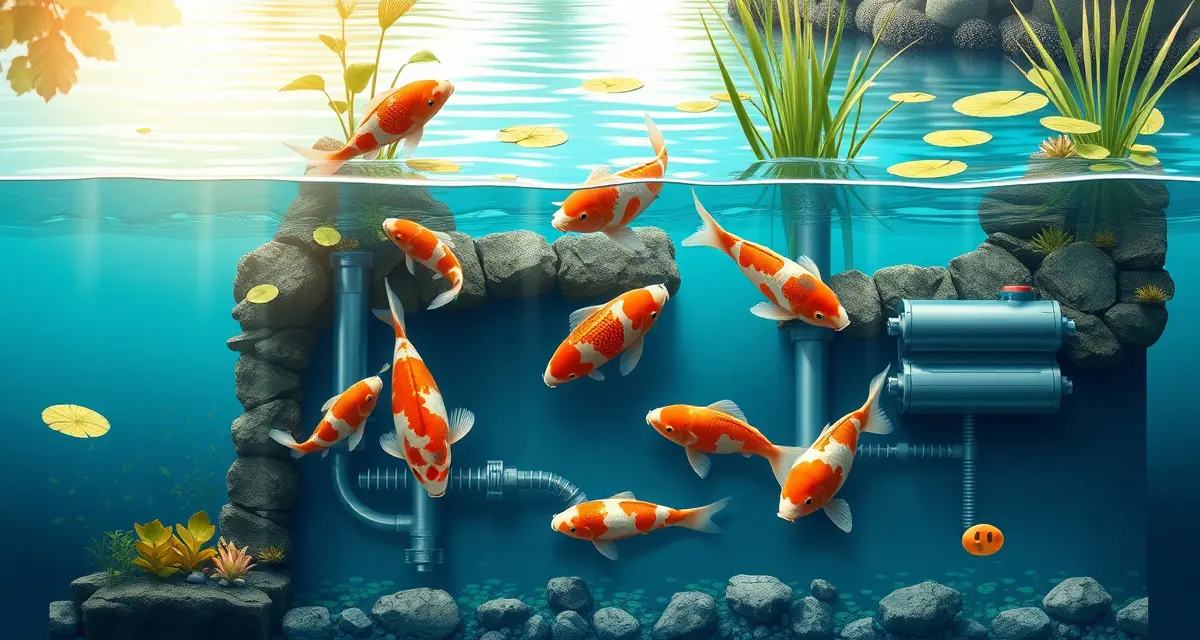
Managing Organic Load in Koi Ponds: Feeding, Filtration, and Water Quality
Reducing koi feeding by 20% in summer can decrease ammonia production by 25% while maintaining adequate fish nutrition. This relationship between feeding and water quality is direct and quantifiable, and it's one of the most underused management levers available to pond owners.
Organic load is the total organic material in your pond system: fish waste, uneaten food, decaying plant matter, and other organic sources. When organic load exceeds what your filtration system can handle, water quality deteriorates and disease risk rises. Managing it effectively is about understanding inputs, outputs, and how they interact.
TL;DR
- High ammonia and nitrite directly damage gill tissue and immune function 2.
- Elevated organic matter fuels bacterial pathogen populations 3.
- The same number of fish you stocked as tosai at 6 inches can produce three to five times more waste as nisai or sansai.
- A lightly stocked, well-filtered pond may need only 10-15% weekly.
- A heavily stocked dealer quarantine system may need 30-50% daily.
- Use the 5-minute feeding rule and adjust feeding rates seasonally with water temperature.
The Organic Load Equation
Think of your pond as a balance between organic inputs and organic processing:
Inputs:
- Fish waste (ammonia from gill excretion plus solid fecal matter)
- Uneaten food
- Dead plant material
- Other organic debris (leaves, dust, etc.)
Processing:
- Biological filtration (nitrifying bacteria converting ammonia through the nitrogen cycle)
- Mechanical filtration (removing solid particles before they decompose)
- Water changes (diluting dissolved organic compounds and nitrate)
- Natural bacterial decomposition (organic matter breaking down, with oxygen cost)
When inputs exceed processing capacity, organic compounds accumulate. Ammonia and nitrite rise. Dissolved organic carbon (visible as yellowing water or measured as elevated TDS) accumulates. Disease risk increases because:
- High ammonia and nitrite directly damage gill tissue and immune function
- Elevated organic matter fuels bacterial pathogen populations
- Oxygen is consumed by decomposition, reducing DO available for koi
KoiQuanta's feeding-to-ammonia correlation analysis shows exactly how your current feeding rate translates to pond organic load.
Feeding as the Primary Control Variable
Feeding is the most controllable input to your pond's organic load. You don't get to choose how much waste a given fish produces at a given size. But you absolutely control how much food goes in.
The 5-minute rule (feed only what koi consume in 5 minutes, then remove uneaten food) is a practical guideline. But it's a starting point, not a complete answer.
Temperature-adjusted feeding is more accurate. Koi metabolism slows dramatically with temperature:
- Above 20°C (68°F): normal high-protein feeding up to 2-3% body weight per day
- 15-20°C (59-68°F): reduce to 1-2% body weight, consider switching to wheat germ formula
- 10-15°C (50-59°F): feed every other day or less, low protein/wheat germ only
- Below 10°C (50°F): stop feeding, koi are not digesting food efficiently
- Below 8°C (46°F): no feeding at all
Feeding koi at cold temperatures is both unnecessary and harmful. Undigested food sits in the gut and decomposes, causing internal bacterial disease. The fish may still show interest in food (some koi beg regardless of temperature), but interest is not the same as nutritional need.
Protein-phosphorus relationship: Higher-protein feeds produce more ammonia and phosphate as metabolic byproducts. In summer when growth is prioritized, high-protein diets are appropriate. In autumn, reducing protein content reduces the organic load per fish while still meeting maintenance nutritional needs.
Stocking Density and Organic Load
Each koi in your pond generates a continuous stream of ammonia and solid waste proportional to its size and metabolic rate. As your fish grow, their bioload increases. The same number of fish you stocked as tosai at 6 inches can produce three to five times more waste as nisai or sansai.
This is why re-evaluating your pond's stocking density annually (not just when you add fish) is important management. A pond appropriately stocked for small fish may become organically overloaded as those fish mature, without any new additions.
Signs of chronic organic overload:
- Persistent low-level ammonia or nitrite despite established filtration
- Nitrate rising faster than water changes can address
- Elevated TDS trending upward between water changes
- Green water or algae problems that UV can't fully control
- Chronic low-grade health issues that don't resolve with treatment
If you're seeing these patterns, stocking density reduction is worth considering alongside filtration upgrades.
Filtration Capacity and Organic Load
Your biological filter has a finite capacity for processing ammonia. This capacity is determined by the amount of active nitrifying bacterial biomass it contains, which in turn depends on:
- Filter media surface area
- Water temperature (warm = more active bacteria)
- Dissolved oxygen supply to the filter
- How well the filter is maintained (not over-cleaned)
If your fish population has grown beyond what your filtration system was designed for, you'll see persistent ammonia and nitrite even with perfect feeding management. The solution is filtration upgrade, not just better feeding discipline.
Mechanical filtration removes solid waste before it dissolves and creates ammonia. An efficient mechanical stage (drum filter, vortex chamber, settlement tank) dramatically reduces the organic load reaching your biological filter. This is why the sequence matters: mechanical filtration first, then biological.
Water Changes as Organic Load Management
Regular water changes dilute accumulated dissolved organics (nitrate, dissolved organic carbon, hormones, medications) that biological filtration doesn't address. In heavily stocked ponds, water changes are not optional maintenance; they're a functional requirement of the system.
Water change frequency should scale with stocking density and organic load. A lightly stocked, well-filtered pond may need only 10-15% weekly. A heavily stocked dealer quarantine system may need 30-50% daily.
KoiQuanta's water change impact calculator and ammonia tracking tools work together to show you how your water changes are affecting your organic load parameters over time.
Frequently Asked Questions
How does overfeeding affect koi pond water quality?
Overfeeding affects water quality through two pathways: direct and indirect. Directly, uneaten food decomposes in the pond, releasing ammonia and consuming dissolved oxygen as bacteria break it down. Indirectly, more food means more metabolic activity and more waste production from the fish themselves. Overfeeding is one of the most common causes of ammonia spikes in koi ponds that have established filtration. It's also one of the easiest problems to fix, as reducing feed quantity immediately reduces ammonia production. Use the 5-minute feeding rule and adjust feeding rates seasonally with water temperature.
What causes high organic load in koi ponds?
The primary causes are overfeeding (the most controllable factor), high stocking density relative to filtration capacity, inadequate mechanical filtration (solids not being removed before they decompose), poor pond circulation with dead zones where waste accumulates, organic debris entering from outside (leaves, grass clippings), and infrequent water changes. In established ponds with rising organic load, the most common culprits are fish that have grown significantly since the pond was set up, feeding that hasn't been reduced seasonally, and mechanical filtration that needs cleaning.
How do I reduce organic load without starving my koi?
Reducing feed quantity by 20% at summer temperatures maintains adequate nutrition while meaningfully reducing ammonia production. Switch to lower-protein, more easily digestible wheat-germ-based feeds in autumn. Feed multiple small meals rather than one large feeding, as smaller portions are consumed more completely with less waste. Improve mechanical filtration efficiency to capture solid waste before it decomposes. Perform more frequent partial water changes to dilute accumulated dissolved organics. Maintain or increase water plant coverage, as fast-growing plants take up dissolved nutrients directly. Combine these approaches rather than relying on any single change.
What is Managing Organic Load in Koi Ponds: Feeding, Filtration, and Water Quality?
Managing organic load in koi ponds means controlling the total organic material—fish waste, uneaten food, and decaying matter—that accumulates in your pond. When organic inputs exceed what your filtration can process, ammonia and nitrite spike, harming gill tissue and immune function. Effective management involves balancing feeding rates, filtration capacity, stocking density, and water change frequency to keep water quality stable and fish healthy.
How much does Managing Organic Load in Koi Ponds: Feeding, Filtration, and Water Quality cost?
Managing organic load costs nothing beyond what you already spend on pond keeping—it's a practice, not a product. The main levers are free: adjusting feeding amounts, timing water changes, and optimizing your existing filtration. You may choose to invest in upgraded mechanical or biological filtration, but the foundational techniques of the 5-minute feeding rule and seasonal feeding adjustments require no additional budget.
How does Managing Organic Load in Koi Ponds: Feeding, Filtration, and Water Quality work?
Organic load management works by reducing inputs and increasing processing capacity simultaneously. On the input side, feeding is reduced by up to 20% in summer, cutting ammonia production by roughly 25%. On the output side, biological filtration converts ammonia to nitrite and then nitrate, while water changes export accumulated nitrates. Matching these two sides of the equation keeps the system in balance and water quality stable.
What are the benefits of Managing Organic Load in Koi Ponds: Feeding, Filtration, and Water Quality?
The core benefits are healthier fish, lower disease risk, and more stable water chemistry. High organic load fuels bacterial pathogen populations and directly damages gill tissue, weakening immune response. By keeping organic inputs in check, koi experience less physiological stress, show better color and growth, and are less susceptible to infections. Ponds also stay clearer, require less emergency intervention, and are easier to maintain long-term.
Who needs Managing Organic Load in Koi Ponds: Feeding, Filtration, and Water Quality?
Any koi pond owner benefits from managing organic load, but it becomes critical as fish grow. The same fish stocked as tosai at 6 inches can produce three to five times more waste as nisai or sansai. Heavily stocked ponds, dealer quarantine systems, and ponds with variable seasonal temperatures face the highest organic load pressure. Even lightly stocked hobbyist ponds benefit from seasonal feeding adjustments and consistent water change routines.
How long does Managing Organic Load in Koi Ponds: Feeding, Filtration, and Water Quality take?
Organic load management is an ongoing practice, not a one-time fix. Feeding adjustments take effect immediately—reducing rations today reduces ammonia output within hours. Biological filtration builds over weeks as bacterial colonies establish. Water changes provide rapid relief when levels spike. Seasonally, you'll adjust feeding frequency as water temperature drops below 10°C in autumn and rises again in spring, making this a year-round, continuous management commitment.
What should I look for when choosing Managing Organic Load in Koi Ponds: Feeding, Filtration, and Water Quality?
Focus on three things: feeding discipline, filtration capacity, and water change frequency. Use the 5-minute feeding rule and adjust rations with water temperature. Ensure your biological filter is appropriately sized for your stocking level—a lightly stocked pond may need only 10–15% weekly water changes, while a densely stocked system may need 30–50% daily. Test ammonia, nitrite, and nitrate regularly to confirm your system is processing load effectively.
Is Managing Organic Load in Koi Ponds: Feeding, Filtration, and Water Quality worth it?
Yes. Managing organic load is one of the highest-leverage practices in koi keeping because it's free, immediate, and directly tied to fish health outcomes. Overfeeding is the most common cause of water quality problems, and a simple 20% feeding reduction can cut ammonia production by 25%. Combined with consistent water changes and adequate filtration, organic load management prevents the disease outbreaks and emergency interventions that cost far more in time, stress, and fish losses.
Related Articles
Sources
- Associated Koi Clubs of America (AKCA)
- Koi Organisation International (KOI)
- University of Florida IFAS Extension Aquaculture Program
- Fish Vet Group
- Water Quality Association