Blanketweed in Koi Ponds: Control and Prevention
Blanketweed can double in mass every 2-3 days under optimal light and nutrient conditions. This growth rate is what makes blanketweed -- also called filamentous algae or string algae -- so difficult to control once it takes hold. You remove it today; it's back in force by the weekend. Understanding why it grows and what conditions favor it is more effective than just repeatedly removing it.
KoiQuanta's water test logs reveal nutrient patterns driving blanketweed growth, connecting your algae problem to the chemistry that's feeding it.
TL;DR
- This is why blanketweed often grows less in ponds with vigorous aeration -- more surface agitation means more CO2 is outgassed before algae can use it.
- Effect is not immediate -- takes 4-8 weeks for fresh barley to begin working.
- Partial shading (40-50% of pond surface) combined with nutrient management is often the most effective combination.
- Early detection based on parameter trends reduces treatment costs and fish stress.
- Seasonal changes require adjusted monitoring schedules; automated reminders help maintain consistency.
What Blanketweed Is
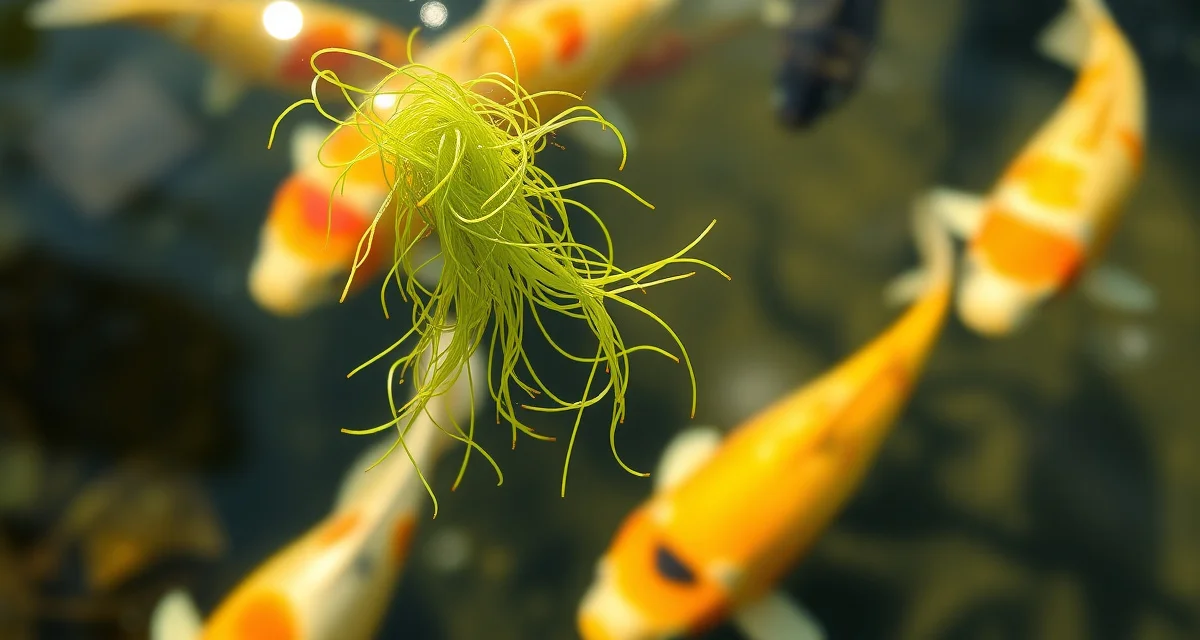
Blanketweed is the collective term for various filamentous algae species that grow as long, hair-like strands in koi ponds. Common species include Spirogyra, Cladophora, and related algae. Unlike green water (suspended single-cell algae), blanketweed is visible as distinct strands or mats.
Why it's a problem beyond aesthetics:
Oxygen fluctuation: Blanketweed photosynthesizes actively during daylight, producing oxygen. At night, it consumes oxygen through respiration. In heavy infestations, nighttime oxygen depletion can be significant -- particularly in warm weather when dissolved oxygen is already lower.
Trapping koi: Large blanketweed mats in a pond can entangle koi, particularly smaller fish. Fish found dead in blanketweed mats are not unusual in ponds where the problem is allowed to progress unchecked.
Filter clogging: Blanketweed that breaks free from surfaces is pulled into filtration. It wraps around pump intakes, clogs filter media, and can reduce filtration efficiency considerably.
Nitrate masking: Blanketweed consumes nitrate, which sounds beneficial but creates a problem -- you can't accurately assess your pond's nitrate level because the blanketweed is consuming it faster than it accumulates. When you remove large amounts of blanketweed, a nitrate spike can follow.
Why Blanketweed Grows
Blanketweed requires: light, nutrients (primarily nitrate and phosphate), and the right pH conditions. Koi ponds provide all three.
Light: Direct sunlight hitting pond surfaces, pond walls, or shallow areas accelerates blanketweed growth dramatically. Shaded ponds have far less blanketweed than sun-exposed ones. This explains why blanketweed is heaviest in summer and in the shallowest, most exposed areas of ponds.
Nutrients: Nitrate from the nitrogen cycle is blanketweed's primary nitrogen source. Phosphate from fish waste, uneaten food, and tap water is the other major nutrient driver. High nitrate and phosphate concentrations create favorable conditions for explosive growth.
pH: Blanketweed grows best at pH 7-8 -- exactly the range koi prefer. You can't adjust pH to suppress algae without harming your fish.
Carbon dioxide: In some cases, CO2 availability limits blanketweed growth. This is why blanketweed often grows less in ponds with vigorous aeration -- more surface agitation means more CO2 is outgassed before algae can use it.
Control Methods
Manual Removal
Removing blanketweed by hand -- twisting it around a stick, pulling it out, raking it off surfaces -- is the simplest approach and the one that doesn't risk harming fish or filter bacteria.
How to remove it effectively: Twist a stick into a mat of blanketweed and rotate to pull out as much as possible. Work systematically around pond edges. Remove all material from the pond -- blanketweed left in the water decomposes and releases nutrients back into the water.
Frequency required: Manual removal needs to happen every 1-3 days during peak growth conditions to prevent mats from reforming. This is time-consuming but safe.
Composting removed blanketweed: It's excellent garden fertilizer. Don't waste it -- it contains the nutrients you've removed from your pond system.
Barley Straw
Barley straw placed in pond water (in mesh bags or as barley extract added to water) releases compounds as it decomposes that suppress algae growth. The mechanism isn't fully understood, but the effect is established by multiple studies.
How to use it: Place barley straw in mesh bags in flowing areas of the pond (near filter outlets or waterfalls). Start with small amounts and increase if needed. Effect is not immediate -- takes 4-8 weeks for fresh barley to begin working. Barley straw extract provides a faster effect.
Limitations: Barley straw is a suppressor, not an eliminator. It reduces growth rate and makes manual removal more manageable, but won't clear a heavy infestation alone. It works best as a preventive measure rather than a treatment.
UV Sterilizers
UV sterilizers kill suspended algae cells passing through the UV chamber, which controls green water. Their effect on blanketweed is indirect -- reducing the population of suspended algae cells that might otherwise settle and grow. UV sterilizers don't directly kill established blanketweed.
Algaecides
Several algaecides are marketed for koi pond use. Many contain hydrogen peroxide, which breaks down into water and oxygen with no persistent residue.
Hydrogen peroxide: Used carefully at correct dilution, can kill blanketweed without harming fish or filter bacteria at the concentrations used. Apply directly to algae rather than diluting into the whole pond for best effect with less fish stress.
Copper-based algaecides: Effective against algae but require careful attention to water hardness and dosing. Copper is toxic to koi at overdose. Not recommended for soft water ponds.
Commercial pond algaecides: Follow label directions carefully. Many products are pH-sensitive -- they work at one pH range and are less effective outside it. Test pH before applying.
Nutrient Reduction
Addressing the nutrient load that feeds blanketweed is the long-term solution.
Reduce nitrate: More frequent water changes, reduced feeding, and increasing water change volume reduce the nitrate available to algae. For the nitrate management context, the koi nitrate guide covers nitrate reduction strategies.
Add aquatic plants: Competitive plants -- particularly submerged oxygenators like hornwort (Ceratophyllum) and floating plants like water hyacinth -- compete with blanketweed for nutrients. A well-planted pond section or bog filter significantly reduces the nutrients available to pest algae.
Improve shading: Adding marginal plants, floating plant covers, or physical shading over the pond removes the light that drives blanketweed growth. Partial shading (40-50% of pond surface) combined with nutrient management is often the most effective combination.
For the pond algae management context covering both blanketweed and green water algae, the koi pond algae management guide covers the complete picture.
Frequently Asked Questions
How do I get rid of blanketweed in my koi pond?
Combine manual removal, nutrient reduction, and shading. Manual removal removes the immediate problem; nutrient reduction (lower nitrate through water changes, reduce feeding, add planted areas) addresses the underlying driver; shading reduces the light energy powering growth. Barley straw or barley extract as a growth suppressant helps keep regrowth slower. Hydrogen peroxide applied directly to algae mats can kill established growth without harming fish at correct dilution. The combination of methods is more effective than any single approach -- blanketweed that's been controlled by reducing nutrients regrows much more slowly than blanketweed controlled only by removal.
What causes blanketweed in koi ponds?
Blanketweed is driven by nutrients (nitrate and phosphate from fish waste and food), light (direct sunlight on pond surfaces), and the neutral-to-slightly-alkaline pH that koi ponds naturally maintain. Koi ponds produce the exact conditions blanketweed thrives in. Heavy feeding, high stocking density, infrequent water changes, and direct sun exposure create the worst blanketweed conditions. Identifying which factors are most significant in your pond guides the most effective response -- a heavily fed, heavily stocked pond needs nutrient management first; a lightly stocked but sun-exposed pond needs shading first.
Is blanketweed harmful to koi?
Yes, in several ways. Large blanketweed mats can entangle and trap koi, particularly smaller fish. Dense blanketweed causes nighttime oxygen depletion through respiration when photosynthesis stops -- a real risk in warm weather when dissolved oxygen is already reduced. Blanketweed mats that break free clog filter intakes and media. When large amounts of blanketweed are removed, the nutrients it was consuming (nitrate, phosphate) are suddenly released back into the water, which can cause other water quality fluctuations. Moderate blanketweed may be manageable, but heavy infestations should be addressed.
What is Blanketweed in Koi Ponds: Control and Prevention?
Blanketweed refers to filamentous algae species — including Spirogyra and Cladophora — that form long, hair-like strands in koi ponds. It thrives when light and nutrients are abundant, doubling in mass every 2-3 days under ideal conditions. Left unchecked, it can overtake a pond rapidly, competing with koi for oxygen and clogging filters. Effective control requires understanding the underlying water chemistry driving its growth, not just repeatedly removing it by hand.
How much does Blanketweed in Koi Ponds: Control and Prevention cost?
Controlling blanketweed doesn't have a fixed price — costs vary depending on your chosen approach. Manual removal is free but labor-intensive. Barley straw treatments are inexpensive, typically a few dollars per bale. UV clarifiers and algaecides range from moderate to significant investments. Partial shading solutions like pond netting are mid-range. The most cost-effective strategy combines nutrient management with early detection, which reduces the need for expensive repeated treatments and minimizes fish stress over time.
How does Blanketweed in Koi Ponds: Control and Prevention work?
Blanketweed control works by targeting the conditions algae need to thrive: excess nutrients, strong light, and available CO2. Reducing dissolved phosphates and nitrates starves the algae. Partial shading (40-50% of pond surface) limits photosynthesis. Strong aeration outgasses CO2 before algae can use it. Barley straw releases compounds that inhibit algae growth, though this takes 4-8 weeks to activate. Combining these methods addresses root causes rather than just treating visible symptoms.
What are the benefits of Blanketweed in Koi Ponds: Control and Prevention?
Effective blanketweed control benefits your entire pond ecosystem. Koi experience less stress and compete less for dissolved oxygen. Water clarity improves, making fish easier to observe and health issues easier to spot early. Filters run more efficiently without constant clogging. Balanced nutrient levels reduce the risk of sudden water quality crashes. A well-managed pond also requires less emergency intervention, saving time and money while creating stable conditions where koi can grow and thrive long-term.
Who needs Blanketweed in Koi Ponds: Control and Prevention?
Any koi keeper with an outdoor pond is a potential blanketweed sufferer, but the problem is most acute for those with high stocking densities, limited natural shade, or ponds in full sun. New pond owners often struggle most, as ponds haven't yet established biological balance. Keepers who feed heavily or have nutrient-rich water are especially vulnerable. If you've repeatedly removed blanketweed only to see it return within days, you need a structured control and prevention strategy.
How long does Blanketweed in Koi Ponds: Control and Prevention take?
There's no instant fix — effective blanketweed control is measured in weeks, not days. Barley straw takes 4-8 weeks to begin working. Nutrient reduction through water changes and feeding adjustments shows results over 2-4 weeks as algae starves. Shading delivers faster results, often reducing growth noticeably within 1-2 weeks. A fully balanced pond with stable parameters may take an entire season to achieve. Consistent monitoring and adjusted seasonal schedules are essential to maintaining control long-term.
What should I look for when choosing Blanketweed in Koi Ponds: Control and Prevention?
Look for a strategy that addresses root causes, not just surface symptoms. Prioritize approaches that tackle nutrient levels — phosphates and nitrates — alongside light management. Choose aeration equipment rated for your pond volume. If using chemical treatments, verify they're safe for koi at your stocking density. Automated water testing or parameter logging tools help with early detection. Avoid single-method solutions; the most effective programs combine shading, nutrient control, biological methods, and consistent monitoring.
Is Blanketweed in Koi Ponds: Control and Prevention worth it?
Yes — proactive blanketweed management is absolutely worth the effort. Reactive removal alone is a losing battle given blanketweed's ability to double in mass every 2-3 days. A structured prevention approach reduces long-term labor, lowers treatment costs, and protects koi health by maintaining stable water quality. Early detection based on parameter trends is far cheaper than emergency interventions. Koi kept in well-managed, algae-controlled ponds show better growth rates, stronger immune function, and longer lifespans.
Related Articles
Sources
- Associated Koi Clubs of America (AKCA)
- Koi Organisation International (KOI)
- University of Florida IFAS Extension Aquaculture Program
- Fish Vet Group
- Water Quality Association