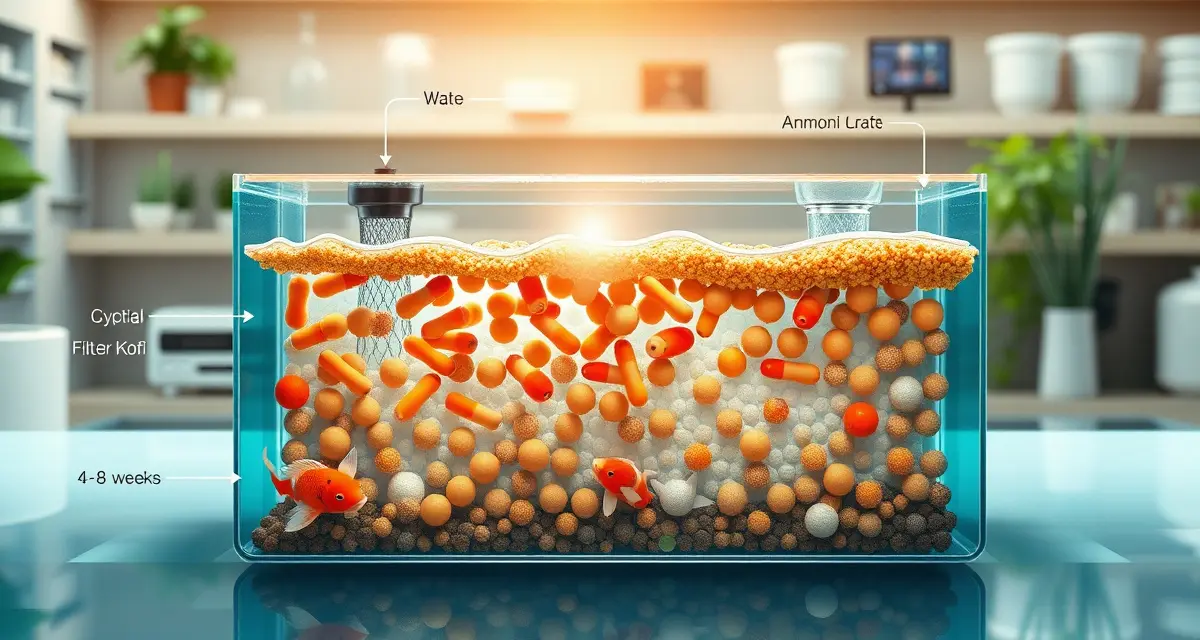
Koi Pond Biofilter Cycling: Building and Monitoring Your Biological Filter
A koi pond biofilter takes 4 to 8 weeks to fully cycle from first ammonia spike to stable nitrate conversion. Patience isn't optional here. It's biologically required. The nitrogen cycle operates on bacterial population dynamics, and bacterial populations can't be meaningfully accelerated beyond their natural doubling time regardless of what any product claims.
Daily ammonia and nitrite tracking through the full cycle produces a completion graph that confirms the filter is genuinely established, not just apparently stable on one good day.
TL;DR
- Do not allow ammonia or nitrite to accumulate above 1.0 ppm with fish in the system.
- The cycle is complete when both ammonia and nitrite consistently return to zero within 24 hours of a significant ammonia dose.
- Test ammonia and nitrite daily and perform partial water changes whenever either exceeds 0.5 ppm.
- If both ammonia and nitrite read zero, your filter is processing the full dose within 24 hours and the cycle is complete.
- A single zero reading isn't sufficient; you want several consecutive zero-ammonia, zero-nitrite readings at 24 hours post-dosing before confirming the cycle is stable.
What the Nitrogen Cycle Does
Your biological filter converts fish waste products from acutely toxic to chronically manageable forms through the sequential action of two types of bacteria:
Nitrospira and Nitrosomonas (nitrifying bacteria) oxidize ammonia (NH3/NH4+) to nitrite (NO2-). This is stage one of the cycle.
Nitrospira (different species from the above) convert nitrite to nitrate (NO3-). This is stage two.
Both processes are entirely aerobic, requiring dissolved oxygen. Both happen on surfaces rather than in the water column, and the filter media provides the surface area that houses the bacterial colonies.
The result: Ammonia (extremely toxic, safe at essentially zero) → Nitrite (very toxic, safe at essentially zero) → Nitrate (much less toxic, manageable through regular water changes)
The Cycling Sequence: What to Expect
A standard cycling process from a fish-free starting point with fishless cycling:
Week 1: Ammonia rises as you dose (or as fish produce it). No bacteria present yet to process it.
Weeks 2-3: Ammonia-oxidizing bacteria (Nitrosomonas etc.) begin establishing. You see the first nitrite appearing as ammonia starts being processed. Ammonia peaks.
Weeks 3-4: Nitrite-oxidizing bacteria (Nitrospira etc.) start establishing, but more slowly than the first-stage bacteria. Nitrite spikes high as the first stage is processing ammonia faster than the second stage can handle nitrite.
Weeks 4-8: Second-stage bacteria population grows. Both ammonia and nitrite begin trending downward. Nitrate appears and rises as the cycle completes.
Completion indicator: Ammonia and nitrite both read zero 24 hours after adding a substantial ammonia dose, while nitrate has risen by a corresponding amount. This demonstrates both stages are fully established.
Fishless Cycling vs. Fish-In Cycling
Fishless cycling (adding ammonia or fish food to an empty pond to provide nitrogen without exposing fish to the ammonia spike) is the preferred method because:
- No fish are harmed by the cycling process
- You can add more ammonia to accelerate bacterial establishment without worrying about fish stress
- The cycle can be monitored purely without confounding fish stress variables
Fish-in cycling (adding fish from the start and managing koi pond water quality tracker during the cycle) is necessary if you already have fish or can't delay stocking. It requires:
- Very light stocking during the cycling period
- Partial water changes when ammonia or nitrite exceeds stress thresholds
- Careful feeding management to control ammonia production
- More intensive monitoring to protect fish during the vulnerability period
If you're fish-in cycling, ammonia above 0.25 ppm or nitrite above 0.25 ppm warrants a partial water change to dilute to safer levels. Do not allow ammonia or nitrite to accumulate above 1.0 ppm with fish in the system.
Seeding: Accelerating the Cycle
While you can't bypass the biological process, you can start with a larger bacterial population through seeding:
Filter media from an established filter is the most effective seed material. If you can obtain a portion of cycled filter media from another koi keeper or dealer, adding it to your new filter provides millions of established bacteria. This can reduce cycling time by half or more.
Established pond water contains some free-floating bacteria but much less than media, so it's helpful but less impactful than media seeding.
Commercial bacteria products (Dr. Tim's Aquatics, Dr. Novak's Cycle, Microbe-Lift Nite-Out II) contain relevant bacterial species and are genuinely helpful for reducing cycling time, particularly in fishless cycling scenarios. Read labels carefully, as not all bacteria products contain the specific species that establish in pond biofilters.
Potted aquatic plants from established ponds contribute some attached bacteria along with the benefits they bring directly.
What Disrupts an Established Cycle
Once your cycle is complete, certain events can partially or fully crash the biological filter:
- Antibiotic treatments that kill bacteria systemically, including beneficial nitrifiers
- Chlorine or chloramine from untreated tap water additions; always dechlorinate
- Potassium permanganate at therapeutic doses, which is bacteriostatic to nitrifiers
- Formalin at therapeutic doses, which is similarly harmful to beneficial bacteria
- Extended power outages cutting off the oxygen supply to aerobic filter bacteria
- Extreme temperature swings above 35°C or approaching 0°C
- Physical filter cleaning that removes too much of the bacterial biomass at once
When any of these events occurs, treat the following period as a mini-cycle and increase monitoring frequency accordingly.
KoiQuanta's ammonia tracking and nitrite/nitrate monitoring tools are where you build the daily record that shows your cycle progression and confirms completion.
Frequently Asked Questions
How long does it take to cycle a koi pond filter?
A typical koi pond biofilter takes 4 to 8 weeks to fully cycle from scratch, though seeded filters can establish more quickly. The timeline depends on water temperature (warmer water supports faster bacterial growth, and cycling in winter can take twice as long), ammonia levels during cycling (enough food for bacteria, but not so much it inhibits them), and whether you're using established seed media. Fishless cycling allows better control of conditions. Patience and daily monitoring are required. The cycle is complete when both ammonia and nitrite consistently return to zero within 24 hours of a significant ammonia dose.
Can I add koi before my biofilter is fully cycled?
Yes, but it requires careful management. Stock very lightly, keeping to a fraction of your eventual fish load. Test ammonia and nitrite daily and perform partial water changes whenever either exceeds 0.5 ppm. Reduce feeding to minimum necessary for fish health. The fish produce the ammonia that drives bacterial establishment, but they're also vulnerable to the ammonia and nitrite that accumulate during the process. If you have the option of fishless cycling first, it's safer for the fish.
How do I know when my koi pond filter is fully cycled?
The definitive test: add a standard ammonia dose to the pond (equivalent to what your fish load produces) and test 24 hours later. If both ammonia and nitrite read zero, your filter is processing the full dose within 24 hours and the cycle is complete. A single zero reading isn't sufficient; you want several consecutive zero-ammonia, zero-nitrite readings at 24 hours post-dosing before confirming the cycle is stable. KoiQuanta's daily tracking produces the historical data showing the gradual decline of both parameters toward zero over weeks, confirming genuine cycle completion rather than a lucky single measurement.
What is Koi Pond Biofilter Cycling: Building and Monitoring Your Biological Filter?
Koi pond biofilter cycling is the process of establishing colonies of beneficial bacteria inside your biological filter that convert toxic fish waste into safer compounds. Starting from a new pond, ammonia from fish waste feeds Nitrosomonas bacteria, which produce nitrite, which then feeds Nitrospira bacteria to produce nitrate. This nitrogen cycle takes 4 to 8 weeks to fully establish and is the biological foundation every koi pond requires before it can safely sustain fish long-term.
How much does Koi Pond Biofilter Cycling: Building and Monitoring Your Biological Filter cost?
Biofilter cycling itself costs nothing beyond the equipment you already own — the bacteria grow naturally given time, ammonia, and oxygen. Your main expenses are a reliable liquid test kit for ammonia and nitrite (around $20–$40), and optionally a bacterial starter culture product to seed the filter. Budget for partial water changes during the cycle, which add modest water and dechlorinator costs. The real investment is time: 4 to 8 weeks of daily monitoring and patience.
How does Koi Pond Biofilter Cycling: Building and Monitoring Your Biological Filter work?
Cycling works by introducing ammonia into the filter — either from fish waste or a fishless ammonia source — which feeds Nitrosomonas bacteria that colonize your filter media. Those bacteria produce nitrite, which in turn feeds Nitrospira bacteria. As both colonies grow, they process ammonia and nitrite faster and faster. The cycle is complete when both readings return to zero within 24 hours of a meaningful ammonia dose, indicating sufficient bacterial populations are established.
What are the benefits of Koi Pond Biofilter Cycling: Building and Monitoring Your Biological Filter?
A properly cycled biofilter protects koi from ammonia and nitrite poisoning, which are the leading causes of stress, disease, and death in new ponds. Established beneficial bacteria work continuously to detoxify waste, stabilizing water chemistry and reducing the need for emergency water changes. A cycled filter also supports higher fish loads, improves long-term water clarity, and creates a resilient biological system that recovers quickly from disturbances like partial cleanings or temperature swings.
Who needs Koi Pond Biofilter Cycling: Building and Monitoring Your Biological Filter?
Any koi keeper setting up a new pond or filter system needs to understand and complete biofilter cycling. It is equally essential after major filter cleanings, adding new media, or restarting a pond after winter. Hobbyists adding koi to an uncycled pond risk fish losses within days. Even experienced keepers benefit from tracking the cycle with daily tests, as water that looks clean can still carry lethal ammonia or nitrite levels invisible to the naked eye.
How long does Koi Pond Biofilter Cycling: Building and Monitoring Your Biological Filter take?
A koi pond biofilter takes 4 to 8 weeks to fully cycle under normal conditions. The first ammonia spike typically appears in week one, followed by a nitrite spike around weeks two to three as the second bacterial colony begins establishing. Both readings must consistently return to zero within 24 hours of dosing before the cycle is confirmed complete. Temperature, seeding methods, and ammonia levels all affect timeline, but no product can meaningfully accelerate bacterial doubling time beyond biological limits.
What should I look for when choosing Koi Pond Biofilter Cycling: Building and Monitoring Your Biological Filter?
When evaluating your biofilter cycling progress, look for a daily test kit that measures ammonia and nitrite accurately in the 0–4 ppm range — liquid reagent kits outperform strips. Choose filter media with high surface area to support larger bacterial colonies. Avoid over-cleaning or disturbing filter media during the cycle. If using a bacterial starter product, select one containing live Nitrosomonas and Nitrospira strains. Most importantly, look for the pattern: ammonia peaks, nitrite follows, then both fall to zero and hold.
Is Koi Pond Biofilter Cycling: Building and Monitoring Your Biological Filter worth it?
Yes — cycling your biofilter before or alongside introducing koi is non-negotiable if you want fish to survive and thrive. Skipping or shortcutting the process leads to toxic ammonia and nitrite buildup that stresses immune systems, causes hemorrhaging, and kills fish before visible symptoms appear. The 4 to 8 week investment of daily testing and patience pays dividends for the entire life of the pond. No filtration equipment, medication, or water treatment replaces an established biological filter.
Related Articles
Sources
- Associated Koi Clubs of America (AKCA)
- Koi Organisation International (KOI)
- University of Florida IFAS Extension Aquaculture Program
- Fish Vet Group
- Water Quality Association