Koi Pond Drum Filter: Benefits and Installation Guide
A correctly sized drum filter removes waste faster than koi can produce it in normal stocking conditions. This is the metric that matters for mechanical filtration -- not how clean the water looks right after cleaning, but whether the filter is keeping pace with continuous waste production. Drum filters achieve this better than any other single mechanical filtration component because they filter continuously and clean automatically.
KoiQuanta's equipment log tracks drum filter maintenance and links to koi pond water quality tracker events, so you can see the relationship between filter performance and water chemistry over time.
TL;DR
- Entry-level units for hobbyist koi ponds start at $800-1,200 and professional units for dealer facilities are $2,000-8,000+.
- If your pump delivers 3,000 gallons per hour and your drum filter is rated to 2,000, you're overloading it -- solids will be pushed through rather than captured.
- A drum filter working at 60-70% of its rated capacity handles peak loads better than one working at 95% capacity.
- The drum filter outlet (filtered water exit) is typically 30-40cm below the inlet -- you need elevation to accommodate this.
- A drum filter working at 60-70% of rated capacity handles peak feeding seasons and higher fish loads better than one running at maximum capacity continuously.
How a Drum Filter Works
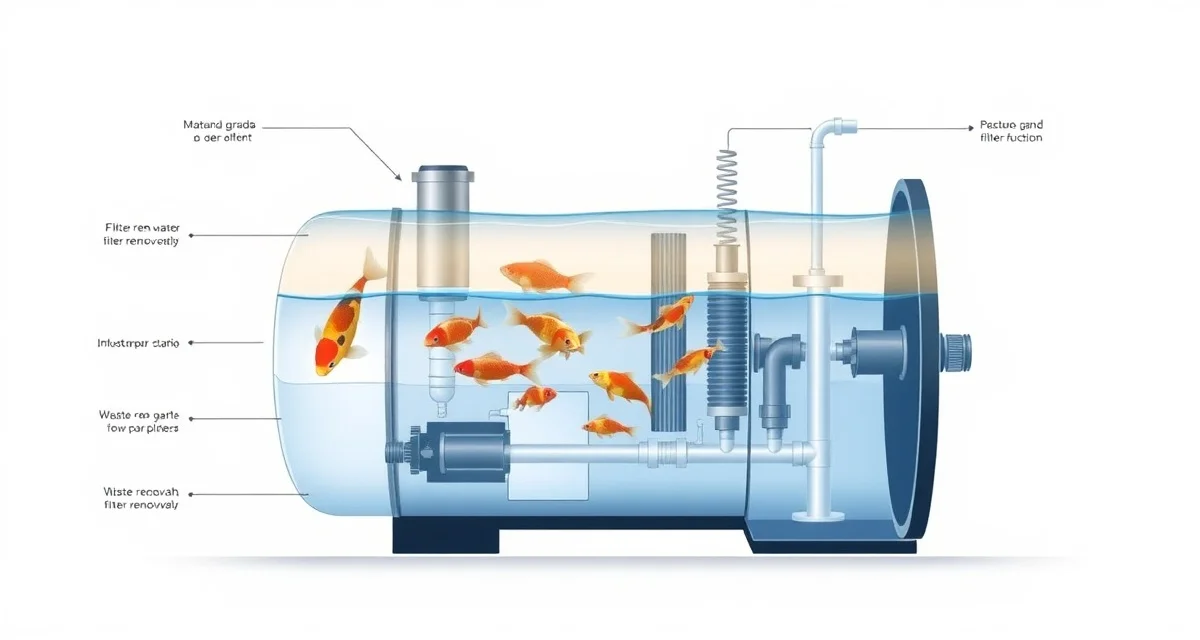
A drum filter consists of a rotating cylindrical drum covered with fine mesh screen (typically 60-100 micron mesh). Pond water enters the drum from the inside, passes through the mesh, and exits as filtered water. Solid particles are trapped on the inner surface of the mesh.
The self-cleaning mechanism: As the mesh becomes blocked with solids, a sensor detects the restriction (usually by measuring water level difference inside vs. outside the drum, or by timer). This triggers the cleaning cycle: high-pressure spray jets mounted outside the drum spray through the mesh from the outside, knocking the trapped solids off the mesh into a waste trough. The waste water is discharged to a drain. The drum rotates continuously during normal operation so that each section of the mesh passes through the spray zone and is cleaned.
Continuous operation: Unlike a bead filter that requires manual backwash or a vortex that periodically accumulates solids, a drum filter operates continuously without manual intervention except for occasional cleaning of the spray nozzles and waste trough.
Drum Filter Advantages
Fine mechanical filtration: 60-100 micron mesh removes very fine particles that other mechanical filters pass. Finer particles are what cause the green water effect in pond systems -- fine algae cells and organic particles small enough to bypass coarser mechanical filtration.
No media bed disruption: Unlike bead filters, drum filter cleaning doesn't disturb a biological media bed. The drum itself has no biological media -- it's purely mechanical.
Continuous self-cleaning: No manual backwash schedule to manage. The drum cleans itself when sensors indicate need, or on a timer.
Low head loss: Drum filters are gravity-fed with low head requirements, so they don't significantly reduce pump efficiency.
Waste is discharged automatically: The solids removed by the spray jets go to drain automatically, removing them from the system entirely rather than recirculating them.
Drum Filter Limitations
Cost: Drum filters are considerably more expensive than bead filters or vortex chambers of comparable capacity. Entry-level units for hobbyist koi ponds start at $800-1,200 and professional units for dealer facilities are $2,000-8,000+.
Gravity-fed requirement: Drum filters are typically gravity-fed, meaning they need to be positioned below pond water level. This influences system design -- the pond needs to gravity-drain to the drum filter, and the drum filter outlet is below the drum, requiring a return pump to push filtered water back to the pond.
No biological filtration: A drum filter is purely mechanical. It must be used in combination with biological filtration (bead filter, sump, moving bed filter, or other biological stage). It's the first step in the filtration chain, not the complete system.
Spray nozzle maintenance: The high-pressure spray nozzles can clog with mineral deposits in hard water areas. Periodic cleaning of nozzles is needed.
Sizing a Drum Filter
Drum filters are sized primarily by flow rate (gallons or liters per hour) and solids load (grams of solids per hour).
Flow rate: The drum filter must handle your full pond circulation rate. If your pump delivers 3,000 gallons per hour and your drum filter is rated to 2,000, you're overloading it -- solids will be pushed through rather than captured. Select a drum filter rated for at least your pump's maximum flow at operating head.
Solids load: Koi produce significant waste. A drum filter sized for the flow rate but undersized for the solids load will clean continuously (constantly triggering the cleaning cycle) and may not keep up in heavy feeding seasons. Manufacturers typically provide solids load ratings -- match to your expected stocking density.
The standard guidance: For koi ponds, size up from the minimum. A drum filter working at 60-70% of its rated capacity handles peak loads better than one working at 95% capacity.
System Design with a Drum Filter
Typical Position in the System
Drum filter is the first stage after the pond:
- Pond bottom drain(s) -- gravity-fed to the drum filter
- Drum filter -- removes fine solids, gravity outlet to biological filtration
- Biological filtration (moving bed, bead filter, or sump) -- processes ammonia/nitrite
- Return pump -- returns filtered water to the pond
Gravity Feed Requirements
The drum filter must be positioned so that pond water can flow by gravity from the bottom drain(s) to the drum filter inlet. This typically means the drum filter is external to the pond, at or below pond bottom drain level. The drum filter outlet (filtered water exit) is typically 30-40cm below the inlet -- you need elevation to accommodate this.
Return Pump Selection
Because filtered water exits the drum filter at low elevation (below pond drain level), the return pump must pump water back up to the pond. This is often the only significant head in the system. Size your return pump for the flow rate you want at the head height of your pond.
Installation Considerations
Location: Drum filters need to be accessible for maintenance -- checking spray nozzles, clearing waste trough, accessing controls. Position the unit so you can work around it without difficulty.
Drainage: The waste outlet from the drum filter needs to connect to a drain. Drum filter waste is continuous in high-load conditions -- ensure your drain can handle the volume.
Waste water volume: In normal operation, waste water from the cleaning cycle is a small fraction of total flow (2-5%). In heavy load conditions or initial startup, it can be higher. Factor this into your water change calculations if you're in a water-sensitive environment.
Freeze protection: If your drum filter is in an unheated external location in a cold climate, freeze protection for the spray water supply may be needed.
For the complete filtration system context including where the drum filter fits alongside biological filtration, the koi pond filtration guide covers system design. For the bead filter as a biological filtration partner to the drum filter, the koi bead filter guide covers biological filtration in detail.
Frequently Asked Questions
How does a drum filter work in a koi pond?
Pond water enters the interior of a rotating drum covered with fine mesh (60-100 microns). Water passes through the mesh; solids are trapped on the inner surface. When the mesh becomes blocked, sensors or a timer trigger the cleaning cycle: high-pressure jets spray through the mesh from outside, knocking solids into a waste trough that drains automatically. The drum rotates continuously so all sections of the mesh are cleaned. This continuous automatic cleaning removes solids from pond water without manual intervention, providing finer filtration than vortex chambers or settling chambers.
How do I size a drum filter for my koi pond?
Select a drum filter rated for a higher flow rate than your pump's maximum output at operating conditions -- if your pump delivers 3,000 gallons/hour at operating head, choose a drum filter rated for at least 3,500-4,000 gallons/hour. Also consider solids load: for heavily stocked koi ponds, choose a unit rated above the minimum for your flow rate. A drum filter working at 60-70% of rated capacity handles peak feeding seasons and higher fish loads better than one running at maximum capacity continuously. When in doubt, the next model size up is almost always worth the cost difference.
Is a drum filter worth the cost for a hobbyist koi pond?
It depends on the size and stocking of your pond, and how much time you want to spend on mechanical filtration maintenance. For ponds above 3,000-4,000 gallons with normal koi stocking, a drum filter typically outperforms alternatives in water clarity and reduces time spent on manual cleaning compared to vortex chambers or bead filter backwash management. For smaller ponds or lower-stocking situations, a well-sized bead filter or vortex chamber at considerably lower cost may be sufficient. For dealers and serious breeders, the drum filter is the standard mechanical filtration choice because of its reliability and capacity at scale.
What is Koi Pond Drum Filter: Benefits and Installation Guide?
A koi pond drum filter is a mechanical filtration device that continuously removes solid waste from pond water by passing it through a rotating drum screen. Unlike static filters that require manual cleaning, drum filters automatically backwash when pressure builds up, keeping filtration consistent 24/7. They outperform other mechanical filtration methods because they keep pace with continuous waste production rather than just clearing water after a manual clean cycle.
How much does Koi Pond Drum Filter: Benefits and Installation Guide cost?
Entry-level drum filters for hobbyist koi ponds typically cost $800–1,200, while professional-grade units for dealer facilities or large installations range from $2,000 to $8,000 or more. Beyond the unit itself, budget for plumbing, a suitable pump, and electrical connection for the auto-backwash system. Choosing a correctly sized unit upfront is more cost-effective than replacing an undersized filter after water quality problems emerge.
How does Koi Pond Drum Filter: Benefits and Installation Guide work?
Water from your koi pond enters the drum filter through an inlet and passes through a fine rotating mesh screen that captures solid waste particles. When solids accumulate and water pressure increases, the drum automatically rotates and spray jets rinse the waste into a drain. Filtered water exits through an outlet typically 30–40cm lower than the inlet, so gravity and flow carry clean water back to the pond continuously.
What are the benefits of Koi Pond Drum Filter: Benefits and Installation Guide?
Drum filters offer continuous, automatic mechanical filtration that keeps pace with waste production in normal stocking conditions. Unlike static or bead filters, they don't require manual intervention to maintain performance. Running a unit at 60–70% of rated capacity provides headroom to handle peak feeding seasons and higher fish loads without solids breaking through. They also integrate well with water quality monitoring, making it easier to correlate filter performance with pond chemistry.
Who needs Koi Pond Drum Filter: Benefits and Installation Guide?
Any koi keeper who wants consistent water quality without daily manual filter maintenance benefits from a drum filter. They are especially valuable for ponds with moderate to heavy fish loads, those running high-performance feeding programmes, or hobbyists who want reliable filtration during holidays or busy periods. Dealers and aquatic facilities with large volumes of fish need professional-grade units to manage the continuous waste output that smaller pond filters cannot handle.
How long does Koi Pond Drum Filter: Benefits and Installation Guide take?
Physical installation of a drum filter typically takes a few hours for an experienced hobbyist or a half-day for a first-time installer, assuming plumbing access is straightforward. Factor in additional time for pipework modifications, electrical connection, and levelling the unit correctly to ensure proper drainage. Once installed, the filter runs automatically, requiring only periodic checks of spray jets and screens — a routine inspection takes around 10–15 minutes.
What should I look for when choosing Koi Pond Drum Filter: Benefits and Installation Guide?
Match the filter's flow rate rating to your pump output, ensuring the pump does not exceed the drum's rated capacity — overloading pushes solids through rather than capturing them. Aim for a unit where your normal flow sits at 60–70% of rated capacity for performance headroom. Check screen mesh size suits your fish load and feed type, verify outlet height fits your pond setup, and confirm the backwash system connects easily to a suitable drain.
Is Koi Pond Drum Filter: Benefits and Installation Guide worth it?
Yes, for serious koi keepers a drum filter is one of the highest-value equipment upgrades available. It removes the bottleneck that manual mechanical filtration creates, protects biological filtration from overloading with solids, and reduces the labour of pond maintenance. The upfront cost is offset by better fish health, more stable water chemistry, and fewer emergency interventions. If your current setup struggles to keep pace with waste production, a correctly sized drum filter solves that problem reliably.
Related Articles
Sources
- Associated Koi Clubs of America (AKCA)
- Koi Organisation International (KOI)
- University of Florida IFAS Extension Aquaculture Program
- Fish Vet Group
- Water Quality Association