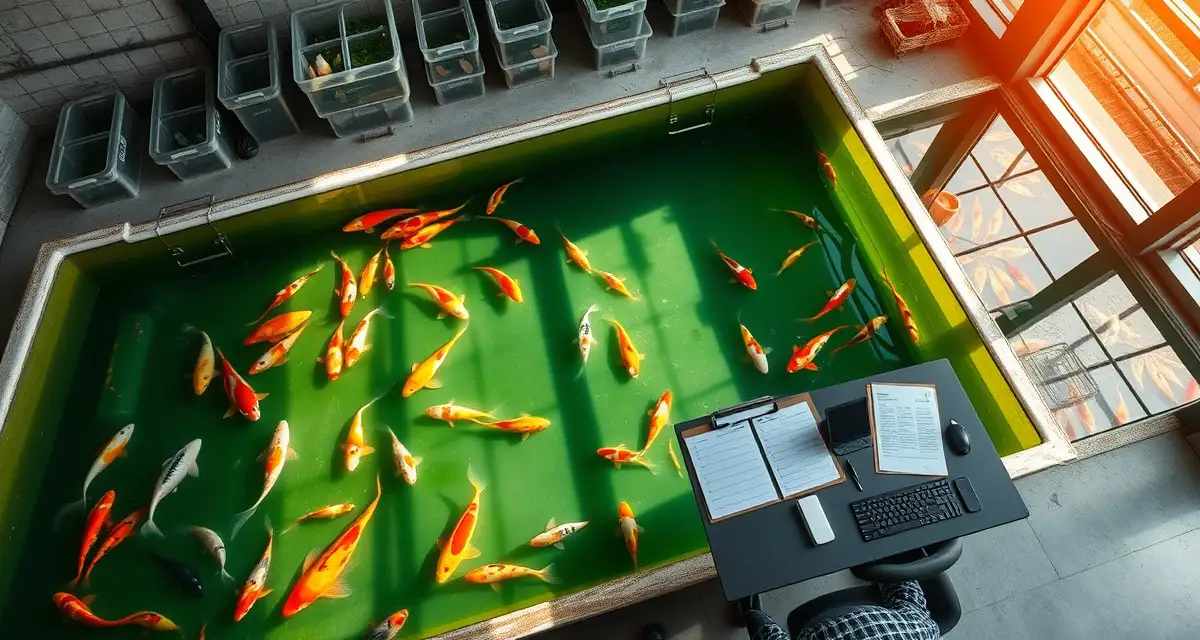
Koi Inventory Management for Dealers
The average koi dealer moves 300-500 fish per month with no dedicated tracking system. Most rely on a combination of handwritten notes, spreadsheets, and memory -- and the gaps in that approach become expensive when disputes arise, when health history is needed for a returning customer, or when a compliance inspector asks for records.
Koi inventory management is different from general retail inventory because each fish has a health identity that follows it from arrival through sale. A koi that passed through quarantine, received specific treatments, and was tested for KHV has a history that needs to be linked to its sale record -- not just for compliance, but for professional credibility.
TL;DR
- Review aging inventory (fish that have been in the system more than 30-60 days without selling may need pricing adjustment or may indicate a health pattern worth investigating).
- This linking means that if a customer calls 6 months after purchase with questions about the fish's health history, you can pull up the sale record and immediately see the entire quarantine history.
- KoiQuanta connects observations, water data, and treatment records in one searchable history.
- Early detection based on parameter trends reduces treatment costs and fish stress.
- Seasonal changes require adjusted monitoring schedules; automated reminders help maintain consistency.
What Dealer Inventory Management Requires
A usable dealer inventory system for koi needs to handle several workflows that general inventory platforms don't accommodate:
Individual fish tracking: At the premium end of the market, you're not selling "one kohaku," you're selling a specific individual fish with a specific history. Individual fish records link quarantine records, health events, growth photos, and eventually a sale record to that specific fish.
Lot tracking: For volume operations, batch-level tracking groups fish by lot (arrival date, source, quarantine batch) rather than tracking individually. Health events, treatments, and test results are attached to the lot rather than individual fish.
Health history integration: Quarantine records, treatment logs, and health events need to be accessible at point of sale. A salesperson answering a customer's question about disease history should be able to pull that information in seconds, not spend time searching through paper files.
Sale record with health documentation: When a fish is sold, the sale record should capture the buyer's information alongside the fish's health history -- creating the documentation trail that protects both parties if a post-sale dispute arises.
KoiQuanta's dealer tier includes fish inventory with individual health records from quarantine to sale, linking the health history of each fish to its eventual sale record in a single system.
Setting Up Your Inventory System
When a new shipment arrives, the first task is intake logging:
- Source (breeder or supplier name and location)
- Arrival date
- Lot number or shipment identifier
- Species and variety breakdown
- Initial quantity
- Condition assessment at arrival (good/fair/poor)
- Any mortality noted at arrival
This initial intake record is the foundation for everything downstream. Quarantine records, treatment logs, and test results are all attached to this lot. When fish are sold from the lot, they carry this history with them.
For individual fish at the high-value end, photograph and describe each fish at intake. The photo serves two purposes: it documents the fish's condition at arrival (important for insurance and for setting customer expectations about pattern development) and it becomes the reference photo for the fish's KoiQuanta profile.
Quarantine to Inventory Transition
When quarantine is complete and fish are cleared for sale, they transition from quarantine status to available inventory. In KoiQuanta, this happens when you mark a quarantine batch as complete and discharged. The health records from quarantine stay linked to the fish -- they don't disappear when the quarantine period ends.
This is the point where price and display information are added to the record: the asking price, the location in the facility (holding tank number), and any sales notes that help staff describe the fish to customers.
How to Track Your Koi Inventory as a Dealer
The practical daily workflow:
Morning: Check all holding tanks. Any fish showing signs of illness or death are noted immediately in the system. Water parameter checks are logged for each holding system. This provides the baseline for the day and creates an ongoing health record for each holding system.
During the day: Customer purchases are logged at point of sale, removing the fish from available inventory and creating a sale record linked to the fish's history. Any new arrivals or quarantine batches created are logged.
Weekly: Review mortality rates by lot and by holding system. Review aging inventory (fish that have been in the system more than 30-60 days without selling may need pricing adjustment or may indicate a health pattern worth investigating). Review upcoming quarantine completion dates so you can prepare available inventory.
Linking Quarantine Records to Sale Records
This is the feature that differentiates purpose-built koi dealer software from generic inventory tools. Can I link quarantine records to sale records in KoiQuanta?
Yes -- when a fish is sold from KoiQuanta's dealer inventory, the sale record captures the buyer information and automatically includes a reference to the quarantine records for that lot or individual fish. The quarantine certificate (if generated) is linked to the sale record for future reference.
This linking means that if a customer calls 6 months after purchase with questions about the fish's health history, you can pull up the sale record and immediately see the entire quarantine history. If a customer claims disease was present at sale, you can show exactly what testing was performed during quarantine and what the results were.
Managing a Large Koi Dealer Inventory
Volume operations face different challenges than small dealers:
Lot management at scale: Receiving 200 fish in a shipment and tracking them through quarantine requires a system that handles batch entry efficiently, not individual fish data entry for every one. KoiQuanta's batch intake handles this -- you enter lot-level information once, and individual fish can be separated from the lot as they're sold.
Multiple quarantine systems running simultaneously: A busy dealer may have 3-5 quarantine batches in various stages at any time. Seeing the status of each batch -- what day each is on, what treatments are due, what test results are pending -- requires an overview that paper systems can't provide efficiently.
Mortality tracking: High mortality in a specific lot is a signal that warrants investigation. Tracking mortality by lot and by holding system reveals patterns that random note-taking misses.
Sale velocity by variety: Understanding which varieties move quickly versus which sit in inventory helps with purchasing decisions. The data your inventory system holds is the input for better business decisions about what to import and at what quantities.
For the broader dealer operations framework, the koi dealer operations guide covers the full operational context. For treatment documentation specifically, the koi treatment journal guide covers treatment record best practices.
Frequently Asked Questions
How do I track my koi inventory as a dealer?
Start with a system that links health records to inventory records -- this is the core requirement for koi dealer inventory management that general inventory platforms don't provide. At minimum, you need: lot-level intake records (source, arrival date, variety, quantity), quarantine records attached to each lot, treatment and test result logs, and sale records that link buyer information to the lot's health history. KoiQuanta's dealer tier provides all of these in an integrated system designed specifically for koi dealer workflows.
Can I link quarantine records to sale records in KoiQuanta?
Yes. When a fish or lot is sold from KoiQuanta's dealer inventory, the sale record is automatically linked to the quarantine records for that fish. This means the complete health history -- arrival date, quarantine duration, test results, treatments administered -- is accessible from the sale record. You can generate a quarantine certificate at point of sale that includes this information, and the underlying records are stored for future reference if questions arise post-sale.
How do I manage a large koi dealer inventory?
At scale, the key is lot-level tracking rather than individual fish tracking for volume stock, combined with individual tracking for premium high-value fish. Efficient batch intake entry handles large shipments without individual data entry for every fish. An overview dashboard showing all current quarantine batches and their status is essential for managing multiple simultaneous batches. Regular review of mortality rates by lot, sale velocity by variety, and aging inventory reports help you catch problems early and make better purchasing decisions.
What is Koi Inventory Management for Dealers?
Koi inventory management for dealers is a system for tracking each fish from arrival through sale, including quarantine history, treatments, water quality data, and health records. Unlike general retail inventory, koi require individual health identities because a fish's full history affects its value and the customer's confidence. Dealers handling 300–500 fish per month need structured records to resolve disputes, satisfy compliance inspectors, and provide health documentation when customers follow up after purchase.
How much does Koi Inventory Management for Dealers cost?
Dedicated koi inventory software like KoiQuanta is typically offered on a subscription basis, with pricing varying by tier and feature set. Many platforms offer a free trial or entry-level plan. The real cost question is the inverse: dealers running on spreadsheets and memory absorb hidden costs through disputes, lost health records, and missed early disease detection. A structured system often pays for itself by preventing a single significant health loss or compliance issue.
How does Koi Inventory Management for Dealers work?
A dealer-focused koi inventory system works by assigning each fish a record at arrival that captures species, size, source, and condition. As the fish moves through quarantine, observations, water parameters, and any treatments are logged and linked to that record. When the fish sells, the sale is attached to the full history. If a customer calls months later, you pull one record and see everything — quarantine dates, treatment details, test results, and the sale.
What are the benefits of Koi Inventory Management for Dealers?
The primary benefits are professional credibility, dispute resolution, and early health detection. When a customer questions a fish's history, you can produce documented records instantly. Compliance inspectors requesting KHV testing or quarantine logs get clean answers. Operationally, tracking water parameter trends across your inventory lets you catch health issues before they spread, reducing treatment costs and mortality. Aging inventory reports also flag fish sitting 30–60 days, prompting pricing adjustments before they become losses.
Who needs Koi Inventory Management for Dealers?
Any commercial koi dealer moving significant volume needs structured inventory management — particularly those selling high-value fish where health history directly affects price and buyer confidence. Dealers who also service returning customers benefit most, since linked sale and quarantine records let staff answer health questions without relying on memory. Operations with multiple staff or tanks also benefit from shared, searchable records that don't live in one person's notebook or inbox.
How long does Koi Inventory Management for Dealers take?
Setup time depends on the platform and how much historical data you import, but most dealers can begin logging new arrivals immediately and reach a working system within one to two weeks. The ongoing time investment is low — a few minutes per fish at intake, brief daily observations, and water parameter entries. The time saved resolving disputes or reconstructing health histories from scattered notes typically exceeds the time spent maintaining records.
What should I look for when choosing Koi Inventory Management for Dealers?
Look for individual fish records with full health history linking, not just batch or tank-level tracking. Water parameter logging with trend visibility matters for early detection. The system should connect quarantine stages, treatment records, and sale records in one searchable view. Compliance-ready exports for KHV testing or import documentation are important if you handle imported fish. Ease of daily data entry is critical — if logging is slow or cumbersome, staff won't use it consistently enough to be reliable.
Is Koi Inventory Management for Dealers worth it?
For dealers moving meaningful volume, yes. The value isn't just convenience — it's risk reduction. A single health dispute on a high-value fish, a compliance inspection with incomplete quarantine records, or a disease outbreak caught late can cost more than years of software fees. Structured inventory also builds customer trust that justifies premium pricing. Dealers who can hand a buyer documented quarantine history and water quality data are selling a more credible product than those who cannot.
Related Articles
Sources
- Associated Koi Clubs of America (AKCA)
- Koi Organisation International (KOI)
- University of Florida IFAS Extension Aquaculture Program
- Fish Vet Group
- Water Quality Association