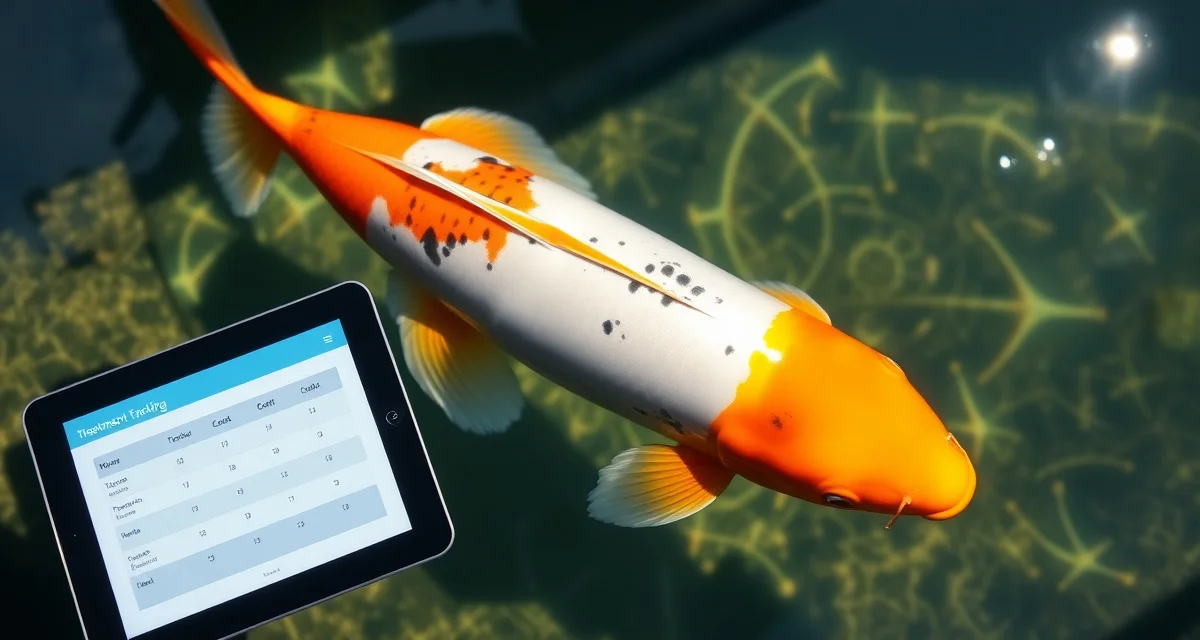
Koi Treatment Journal: How to Track Drug Treatment History
Most koi keepers have a vague memory of what they've treated which fish with, and absolutely no documentation to support that memory.
"I think I used oxytetracycline on that fish last spring. Or was it the one before? It might have been praziquantel actually." If this sounds familiar, you're managing treatment by recollection - which fails in exactly the situations where accurate treatment history matters most: when a fish gets sick again, when a veterinarian asks what you've tried, or when you're trying to determine whether a fish showing antibiotic resistance was undertreated in a previous course.
A treatment journal per fish per tank isn't a bureaucratic nicety. It's the mechanism by which past treatment experience informs future treatment decisions.
TL;DR
- 50 grams of sodium chloride per 200 liters for a 0.3% salt solution.
- Tracking trends over time reveals issues before they become visible in fish behavior.
- KoiQuanta connects observations, water data, and treatment records in one searchable history.
- Early detection based on parameter trends reduces treatment costs and fish stress.
- Seasonal changes require adjusted monitoring schedules; automated reminders help maintain consistency.
What to Record in Every Treatment Entry
Minimum Required Fields
Date and time of treatment: Not "approximately mid-April" - the actual date and time, entered at the time of treatment, not retrospectively.
Fish or tank identifier: Which individual fish, or which koi quarantine program tank (if treating a batch).
Product name and active ingredient: The brand name ("PraziPro") and the active ingredient ("praziquantel at 50 mg/mL"). Brand names change, go out of production, and vary by region. The active ingredient is what matters clinically.
Dose administered: Not just "followed label instructions" - the calculated dose for the specific volume treated. 5 mL of PraziPro into a 300-gallon tank. 50 grams of sodium chloride per 200 liters for a 0.3% salt solution. Specific numbers.
Volume treated: The tank volume at time of treatment, from which the dose was calculated. This allows independent verification of whether the dose was correct and lets you recalculate if needed.
Intended target: What you were treating for. "Dactylogyrus fluke infestation - two fish flashing and rubbing, confirmed on scrape." Not just "parasites."
Outcome and observations: Did the fish improve? Did symptoms resolve? Did the treatment need to be repeated? On what day did clinical signs resolve?
Next treatment date (if applicable): For repeat-treatment protocols (second praziquantel dose in 7–10 days, second antibiotic dose the following morning), log the planned next treatment date at the time of the first treatment entry.
Extended Fields for Antibiotic Treatments
Antibiotic courses warrant additional documentation:
Prescribing veterinarian (if applicable): Name and practice. In the US, prescription antibiotics for fish require a valid veterinarian-client-patient relationship. The prescription details should be in the record.
Full course dates: First dose to last dose. This allows you to confirm the course was completed and wasn't cut short.
Dose interval: Daily, every 48 hours, twice daily - whatever the protocol specifies. If doses were missed, record which ones and why.
Water parameters at time of treatment: Particularly temperature (affects antibiotic uptake), pH, and GH/hardness (affects tetracycline activity in hard water). These affect whether the dose was actually therapeutic.
Post-treatment observation period start date: When the post-treatment hold began and when the required observation period ends.
Why Treatment History Matters
Identifying Resistance Patterns
A fish treated with oxytetracycline in March, then oxytetracycline again in June for a similar presentation, that didn't respond well the second time - that pattern in a treatment journal suggests emerging resistance. Without the treatment record, you'd never connect the two events.
Antibiotic resistance in Aeromonas is increasing in koi populations in direct proportion to antibiotic overuse and incomplete courses. The treatment journal is how you track what your fish have been exposed to and make informed decisions about alternative antibiotics when first-line agents are no longer working.
Supporting Veterinary Consultation
When you call an aquatic veterinarian about a sick fish and they ask "what have you treated this fish with in the past," the answer "I have a complete treatment history I can share with you" produces better advice than "I think I tried something last year."
A full treatment record lets the veterinarian:
- Avoid recommending something that already failed
- Identify patterns that suggest resistance
- Know whether the current antibiotic course is truly a first exposure or a repeat
Dealer Liability Management
For dealers, the treatment journal is a component of the overall quarantine record that protects you if a customer claims the fish was already sick when purchased. A complete treatment history showing what the fish was treated for (if anything), when, at what dose, and the response - with discharge sign-off showing the fish was clear before sale - is the documentation that resolves disputes.
Evaluating Treatment Efficacy
Without records, you're making treatment decisions based on general knowledge. With records across your whole operation over multiple years, you can evaluate:
- Does praziquantel at my standard dose effectively clear flukes within one course, or do I consistently need two?
- What's the typical time to clinical improvement for Aeromonas ulcers in my facility?
- Are certain batches of fish from specific sources requiring more intensive treatment than others?
This kind of operational intelligence only emerges from treatment records that have been maintained consistently.
KoiQuanta Treatment Journal Features
The treatment journal in KoiQuanta is designed around the workflows above:
Integrated dose calculations: The treatment entry form includes the dose calculator - you enter the target concentration, the system pulls the stored tank volume, and calculates the product needed. The calculated dose is stored in the treatment entry as the "dose administered" field.
Treatment course tracking: For antibiotic and multi-dose protocols, the treatment course appears as a timeline - each dose logged as a separate entry within the same course, with the full course completion visible as a single timeline view.
Post-treatment hold timer: Enters automatically on course completion. The treatment journal marks the hold period and flags the completion date. Discharge criteria can't be met until the post-treatment hold is complete.
Individual fish and tank linking: Treatment entries link to the specific fish or tank profile. A fish's full treatment history is accessible from its profile page - all past treatments, all past doses, all outcomes - regardless of which tank it was in when treated.
Exportable records: The treatment history for any fish or lot exports as a PDF for regulatory compliance, veterinary consultation, or customer documentation.
Paper Treatment Journal Format
If you're not using software, here's the minimum structure for a paper treatment journal:
One binder or folder per quarantine tank, with a separate log sheet per treatment event:
Treatment Event Record
----------------------
Date:
Time:
Tank/Fish ID:
Product (brand):
Active Ingredient:
Dose administered (with units):
Tank volume at treatment:
Target treatment:
Water temperature at treatment:
Treatment sequence (1st, 2nd, 3rd dose):
Next treatment date:
Observations:
Outcome:
Keep completed treatment records with the tank or fish file for the duration of the quarantine and for 2+ years after sale (dealer operations) or for the fish's life (personal collection).
Related Articles
- Koi Hemorrhagic Septicemia: Symptoms, Treatment, and Emergency Protocol
- Koi Pop Eye (Exophthalmia): Causes, Treatment, and Recovery
- Should You Prophylactically Treat New Koi During Quarantine?
FAQ
What should I record in a koi treatment journal?
At minimum: date and time of treatment, fish or tank identifier, product name and active ingredient, dose administered with the volume treated, intended target diagnosis, and treatment outcome. For antibiotic courses, add the prescribing veterinarian (if applicable), full course dates, dose interval, water temperature at treatment, and post-treatment hold start date. KoiQuanta's treatment journal structures these fields with built-in dose calculators that auto-populate from stored tank volume.
How do I track which koi received which medications?
The most reliable system links each treatment to a specific fish profile or tank identifier with a timestamped record that includes the product, dose, and date. In KoiQuanta, each fish has its own treatment history that's independent of its tank history - if a fish was treated in a quarantine tank and then moved to a display pond, the full treatment history travels with the fish profile. For paper systems, a file per fish with treatment log sheets provides the same function without the automatic linking.
Can KoiQuanta export treatment records?
Yes - treatment records can be exported as PDF files per fish, per tank, or per lot. For dealer operations, the per-lot export includes all treatment events during the quarantine period alongside the parameter history and daily observation logs, formatted as a compliance documentation package. For individual fish, the treatment history export is a chronological record suitable for veterinary consultation or customer documentation.
What is Koi Treatment Journal: How to Track Drug Treatment History?
A koi treatment journal is a per-fish, per-tank record of every drug treatment administered to your koi. It documents which medications were used, dosages, duration, water parameters at the time, and the fish's response. Rather than relying on memory, it creates a searchable history that informs future treatment decisions, helps identify resistance patterns, and provides veterinarians with accurate information when a fish falls ill again.
How much does Koi Treatment Journal: How to Track Drug Treatment History cost?
Keeping a koi treatment journal costs nothing beyond a notebook or spreadsheet. Digital tools like KoiQuanta offer free or low-cost options that connect treatment records with water parameter data in one searchable system. The real cost savings come from the journal itself: accurate treatment histories reduce redundant treatments, help catch resistance early, and prevent costly mistakes that come from guessing what a fish was previously given.
How does Koi Treatment Journal: How to Track Drug Treatment History work?
For each treatment event, you record the date, fish identity, drug name, dosage, treatment duration, water parameters, and observed symptoms. Over time, entries build a complete clinical picture per fish. When a fish gets sick again, you reference its history to avoid repeating failed treatments or underdosing a second course. KoiQuanta automates reminders and links water data to treatment entries, making the process faster and more consistent.
What are the benefits of Koi Treatment Journal: How to Track Drug Treatment History?
A treatment journal eliminates the guesswork that leads to undertreated infections, repeated drug courses, and antibiotic resistance. It gives veterinarians accurate history to work from, helps you spot trends before they become visible in fish behavior, and reduces both treatment costs and fish stress through early, informed intervention. For multi-tank operations or valuable fish, documented history is the difference between reactive guessing and evidence-based care.
Who needs Koi Treatment Journal: How to Track Drug Treatment History?
Any koi keeper who has ever said 'I think I treated that fish last spring' needs a treatment journal. It is especially critical for keepers with multiple tanks, high-value fish, recurring health issues, or any fish that has received antibiotic treatment. Veterinarians treating koi depend on accurate drug histories to make safe prescribing decisions. If you plan to breed, sell, or exhibit fish, documented treatment records also support buyer confidence and responsible fish husbandry.
Sources
- Associated Koi Clubs of America (AKCA)
- Koi Organisation International (KOI)
- University of Florida IFAS Extension Aquaculture Program
- Fish Vet Group
- Water Quality Association