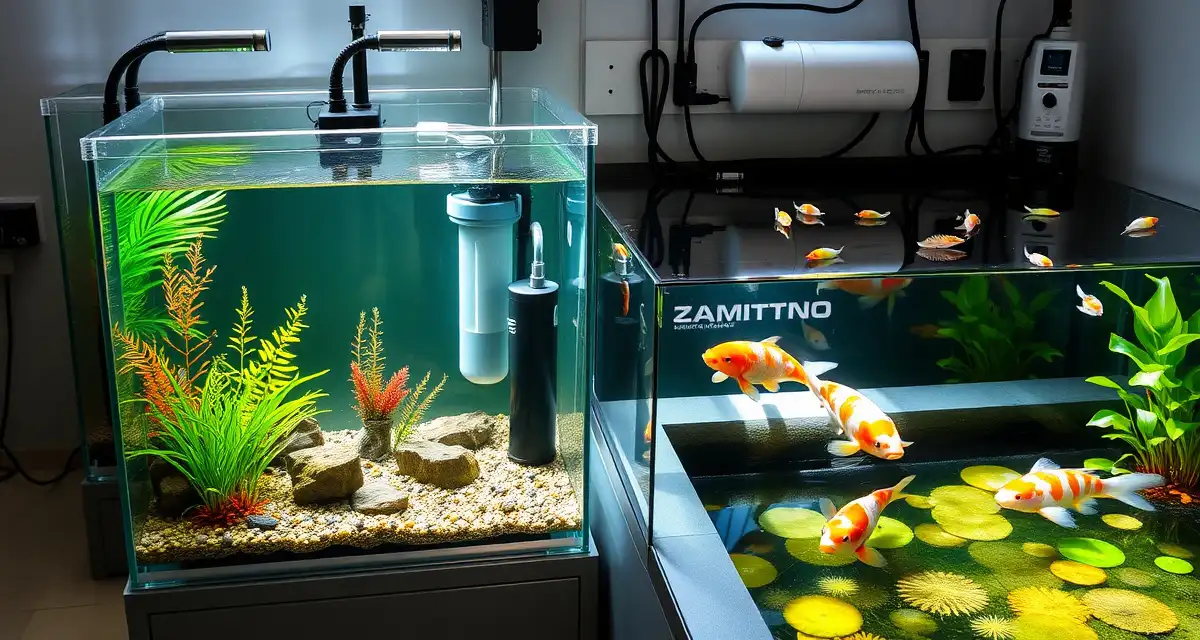
Filtration for Koi Quarantine Tanks
The biofilter is the foundation of display pond management. In quarantine, it becomes a liability.
That's not an exaggeration. The same nitrifying bacteria that keep your display pond parameters stable will be destroyed by antibiotics. The biological media that you've spent months establishing can harbor pathogens. And the standard advice to "cycle your quarantine tank before adding fish" is genuinely difficult to execute when the tank sits empty between batches.
Quarantine filtration is a specific problem with specific solutions. The approach that works in your display pond doesn't transfer.
TL;DR
- One antibiotic course can wipe 70–90% of your biofilter's capacity.
- If you miss two days of changes in a warm quarantine tank with 10 fish, ammonia can hit stressful levels fast.
- In a heavily stocked tank or with actively sick fish, you may need 40–50% daily.
- It's not a substitute for good management, but it buys time during the first 1–2 weeks when a new quarantine tank has no biological capacity.
- Scrub all surfaces with a stiff brush to remove biofilm 3.
- Fill with a chlorine bleach solution (1 cup per 10 gallons) and run for 30 minutes 4.
- Fill with fresh dechlorinated water with sodium thiosulfate to neutralize chlorine 6.
The Core Conflict: Biofilter vs. Treatment
Your display pond's biological filter converts toxic ammonia to nitrite and then to relatively harmless nitrate. This requires living bacteria - Nitrosomonas and Nitrospira - that colonize your filter media.
Most common koi treatments kill these bacteria:
- Antibiotics: Broad-spectrum antibiotics (oxytetracycline, erythromycin, enrofloxacin) kill nitrifying bacteria as collateral damage. One antibiotic course can wipe 70–90% of your biofilter's capacity.
- Potassium permanganate: Kills biofilter bacteria as part of its oxidizing action.
- Some formaldehyde/formalin concentrations: Can damage biofilter bacteria at higher doses.
The cycle after antibiotics: bacteria die → ammonia spikes → ammonia stresses fish that are already immunocompromised → secondary infections → worse outcomes than if you'd just managed the chemistry manually.
Two Approaches to Quarantine Filtration
Approach 1: Mechanical Filtration Only
Don't try to maintain a biofilter in a quarantine tank at all. Run only mechanical filtration - a sponge filter for particle removal, or a simple box filter with filter floss - and manage ammonia through frequent water changes.
This is actually simpler than it sounds:
- Daily 20–30% water changes keep ammonia under control for lightly stocked quarantine tanks
- No biofilter means no colony to protect when you add antibiotics
- No biofilter means no pathogen reservoir in the media
- Easier to sterilize the tank between batches
The downside: you need discipline about water changes. If you miss two days of changes in a warm quarantine tank with 10 fish, ammonia can hit stressful levels fast.
Approach 2: Cycled Biofilter With Treatment Bypass
Some operations maintain a cycled sponge filter in the display pond that can be moved into the quarantine tank for instant cycling. When you need to treat with antibiotics or oxidizers, you pull the sponge filter out, run it in a bucket with dechlorinated water and an air stone to keep the bacteria alive, and return it to the tank after the treatment course.
This takes planning and the bucket-storage method only works for a few days before bacteria populations start declining. But for operations where fish are continuously moving through quarantine, it's the best way to have established biological filtration available on demand.
Managing Ammonia Without a Cycled Biofilter
If you're running mechanical filtration only, here's the water change math:
In a quarantine tank without biological filtration, ammonia comes from:
- Fish respiration and waste
- Uneaten food (don't overfeed in quarantine)
- Dead or dying fish tissue (inspect daily)
A 25% daily water change will maintain acceptable ammonia in a moderately stocked tank (1 inch of fish per 10 gallons) under normal conditions. In a heavily stocked tank or with actively sick fish, you may need 40–50% daily.
Always test ammonia before each water change, not just on a schedule. The schedule is a starting point; the test result tells you if you need more.
If ammonia is rising despite water changes, you have too many fish, too little volume, or a dead fish you haven't found. Check all three.
Zeolite as a Temporary Ammonia Buffer
Zeolite (sodium aluminosilicate) is a natural mineral that adsorbs ammonia. It's not a substitute for good management, but it buys time during the first 1–2 weeks when a new quarantine tank has no biological capacity.
Important limitations:
- Zeolite becomes saturated and stops working without warning
- It releases ammonia back into the water in salt water - so if you're running salt treatment (0.3% or higher), zeolite doesn't work
- It needs regular regeneration (salt soak, then fresh rinse) or replacement
For a quarantine operation running salt as part of the standard protocol, zeolite is not an option. Know what you're running before you stock up on it.
Should You Use a UV Sterilizer in Quarantine?
UV sterilizers kill free-floating pathogens by exposing them to UV light as water flows past the lamp. In a display pond, UV sterilizers help control green water and reduce waterborne pathogen load.
In quarantine, the calculus is different:
Arguments for UV in quarantine:
- Reduces free-floating bacteria and parasites between fish contacts
- May reduce secondary spread if one fish is shedding pathogens
- Useful during post-treatment observation when you want to minimize re-exposure
Arguments against UV in quarantine:
- UV doesn't treat parasites on the fish - it only kills those in the water column
- If you're running effective treatments, waterborne pathogen load is already being addressed
- UV doesn't substitute for treatment or quarantine - it's an adjunct
- Can give a false sense of security
My position: UV in a quarantine tank is useful but not essential. If you have it, run it - particularly during the post-treatment observation period. Don't run it during potassium permanganate treatments (UV degrades PP effectiveness). During most treatments, UV is redundant to the active chemical.
Biofilter Startup for New Quarantine Systems
If you want to maintain a biological filter in your quarantine tank, here's how to cycle it quickly:
- Use seeded media: Take a sponge or filter media from your display pond and put it directly in the quarantine tank filter. Instant biological filtration with established bacteria.
- Use ammonia to feed the cycle: Add a small ammonia source (a pinch of fish food or household ammonia without surfactants) to start the cycle running before fish arrive.
- Dose with bottled bacteria: Products like Tetra SafeStart or Seachem Stability can accelerate cycling. They're not magic but they do reduce the cycle time compared to starting from nothing.
- Test before adding fish: Ammonia and nitrite should both be at or near zero before adding fish to a "cycled" quarantine tank.
Cycling from scratch takes 2–6 weeks. For most quarantine operations, seeded media from the display pond is the practical approach.
Between Batches: Sanitizing the Quarantine System
After every quarantine batch - regardless of health outcome - the quarantine tank and all associated equipment needs to be sanitized before the next batch arrives.
Protocol:
- Drain completely
- Scrub all surfaces with a stiff brush to remove biofilm
- Fill with a chlorine bleach solution (1 cup per 10 gallons) and run for 30 minutes
- Drain completely
- Fill with fresh dechlorinated water with sodium thiosulfate to neutralize chlorine
- Test for residual chlorine before next use
Replace filter media between batches if any disease was present. Biofilm on filter media can harbor pathogens that survive the sanitization if media isn't replaced or fully disinfected.
Related Articles
- Should You Prophylactically Treat New Koi During Quarantine?
- Bacterial Quarantine Protocol for Koi
- Before and After: What Happens When You Actually Implement Koi Quarantine-implementation)
FAQ
Should I use biological filtration in a quarantine tank?
It depends on your treatment protocol. If you're running antibiotics as part of your standard quarantine, biological filtration will be repeatedly destroyed and is hard to maintain. The simpler approach is mechanical filtration only with daily water changes. If you want the security of a biological filter, use seeded media from the display pond and be prepared to remove it during antibiotic treatments.
What happens to my biofilter when I add antibiotics?
Most broad-spectrum antibiotics kill nitrifying bacteria, which causes the biofilter to lose most or all of its ammonia-converting capacity within 24–72 hours. This leads to ammonia spikes that stress already-sick fish. If you're treating with antibiotics, pull the biofilter media to safety and manage ammonia through water changes and testing until the antibiotic course ends and bacterial populations recover.
Do I need a UV sterilizer in quarantine?
UV sterilizers are useful but not essential in quarantine tanks. They reduce free-floating pathogen load in the water column, which is helpful during post-treatment observation periods. They don't treat parasites on the fish and shouldn't be used during potassium permanganate treatments. If you have the equipment, run it - but don't rely on it as a substitute for active treatment protocols.
What is Filtration for Koi Quarantine Tanks?
Filtration for koi quarantine tanks refers to the specialized water management systems used in temporary holding tanks for new or sick koi. Unlike display pond filtration, quarantine filtration must balance water quality with the need to administer medications. Because antibiotics destroy beneficial bacteria, quarantine tanks often rely on mechanical filtration, frequent water changes, and chemical support rather than biological filtration alone. The goal is to maintain safe ammonia and nitrite levels without compromising treatment effectiveness.
How much does Filtration for Koi Quarantine Tanks cost?
Quarantine filtration itself has no fixed cost — it depends on your setup. A basic sponge filter costs $10–30, while a dedicated quarantine system with UV sterilization and mechanical pre-filtration can run $100–300 or more. The real ongoing cost is water — frequent changes of 40–50% daily during treatment add up in dechlorination products and heating. Budget for sodium thiosulfate, water conditioner, and replacement filter media that may need to be discarded after antibiotic courses.
How does Filtration for Koi Quarantine Tanks work?
Quarantine tank filtration works by removing solid waste mechanically, neutralizing ammonia chemically or through dilution, and optionally using UV sterilization to reduce pathogen load. Because antibiotics kill nitrifying bacteria, biological filtration is unreliable during treatment. Instead, daily water changes of 25–50% handle ammonia and nitrite buildup. Sponge filters seeded from an established pond can provide limited biological capacity in the first week or two before medications are introduced.
What are the benefits of Filtration for Koi Quarantine Tanks?
The main benefit is keeping water parameters safe enough for stressed or sick fish to recover without adding the additional burden of ammonia toxicity. Proper quarantine filtration also prevents cross-contamination between your new arrivals and your display pond. It gives you a controlled environment to observe fish, administer medication at precise doses, and perform bleach-based decontamination between batches — protecting the biological investment you've made in your main pond.
Who needs Filtration for Koi Quarantine Tanks?
Anyone who keeps koi should have a quarantine filtration system in place. New fish buyers need it to isolate arrivals before introducing them to an established pond. Hobbyists treating disease need it to medicate without destroying their main biofilter. Breeders and show enthusiasts need it to manage high-volume fish movement safely. Even experienced keepers who rarely lose fish benefit — a single pathogen introduced without quarantine can devastate an entire pond in days.
Sources
- Associated Koi Clubs of America (AKCA)
- Koi Organisation International (KOI)
- University of Florida IFAS Extension Aquaculture Program
- Fish Vet Group
- Water Quality Association