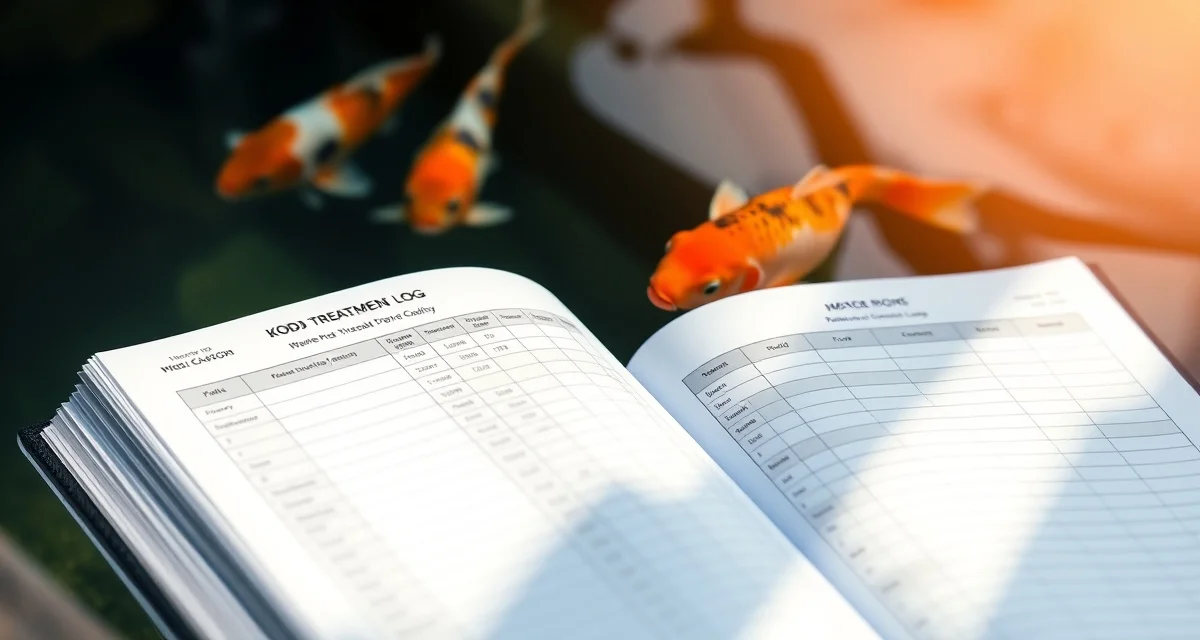
Koi Pond Medication Log Template: What to Record for Every Treatment
USDA auditors identify missing koi pond water quality tracker context in koi treatment records as the most common documentation failure in dealer inspections. This matters for dealers, but it also matters for hobbyists who want records that are actually useful for diagnosis rather than just documentation. A log that says "added formalin 3/15" tells you very little. A log that says "added formalin 3/15 at 25 mL/1000 gallons, water temp 68°F, DO 8.2 mg/L, treating for suspected Costia identified on 3/14 skin scrape" tells you everything you need to understand the treatment decision and its context.
KoiQuanta's context-rich treatment log automatically captures water quality parameters, fish observation, and pond volume alongside every medication entry. This guide covers what a complete treatment record should include and why each element matters.
TL;DR
- A log that says "added formalin 3/15" tells you very little.
- A pond that's lost 10% of volume to evaporation has a 10% higher effective treatment concentration if you're using the same dose.
- Formalin at 72°F and formalin at 82°F are different propositions for the fish.
- These records must be retained for a minimum of 2 years and must be producible during inspections.
- After the treatment is logged, KoiQuanta prompts follow-up observation entries at 24 and 48 hours.
The Core Fields of a Complete Treatment Record
Date and time: When was the treatment applied? For treatments that require specific contact time or that interact with daily parameters (temperature, oxygen), the time of day matters as much as the date.
Product name and concentration: Not just "formalin" - which formalin product, at what stock concentration? Formalin products vary in formaldehyde percentage. Documenting the specific product and lot number ensures you're recording the actual dose rather than an assumed one.
Dose: How much of the product was applied? Express this both as the volume or weight applied and as the calculated concentration in your pond (mL/gallon, ppm, or percentage). The dose in your pond is what matters for efficacy; the volume of product applied is what you need to record for compliance.
Pond volume at time of treatment: Not your pond's nominal volume - its actual volume at the time of treatment, accounting for recent water changes, evaporation, and any volume adjustments. A pond that's lost 10% of volume to evaporation has a 10% higher effective treatment concentration if you're using the same dose. This is how overdoses happen.
Water temperature: Treatment efficacy and toxicity for many medications is temperature-dependent. Formalin at 72°F and formalin at 82°F are different propositions for the fish.
Dissolved oxygen before treatment: Particularly important for formalin and potassium permanganate, which both consume or displace oxygen. Recording pre-treatment DO confirms that conditions were safe for treatment.
pH at time of treatment: pH affects the efficacy of potassium permanganate, the speciation of ammonia, and the behavior of several other medications. A reading before treatment provides the context for interpreting treatment outcomes.
Indication: What are you treating for? "Suspected monogenean fluke infestation identified by..." with the observation that led to the diagnosis. This connects the treatment to the clinical finding.
Fish observations before treatment: How are the fish behaving? What signs prompted treatment? This is the clinical baseline that you compare post-treatment observations to.
Post-Treatment Documentation
A complete treatment record includes follow-up entries:
24 and 48 hours post-treatment: Note the fish response. Are presenting symptoms improving? Are fish eating? Is behavior returning toward normal? Any adverse reactions?
Treatment completion: When the treatment course is finished, document the final outcome. Were presenting signs resolved? If the treatment required multiple doses, document each dose separately.
Follow-up assessment: If disease signs resolved, note the resolution date. If they didn't, document the follow-up decision - was the diagnosis reconsidered? Was treatment extended? Was a different medication tried?
Why Paper Logs Fall Short
A paper treatment log is better than no log, but it has specific limitations. Most paper records capture what was done without capturing the context in which it was done. The water quality parameters at the time of treatment are rarely noted because it requires a second action (testing) and a cross-reference to a different log (water quality log). The time of day is often omitted. The indication - what clinical observation prompted the treatment - is rarely documented in the detail that a post-hoc reviewer needs to understand the treatment decision.
KoiQuanta integrates the treatment log with the water quality log so that parameters at time of treatment are automatically linked to the treatment record. When you initiate a treatment in KoiQuanta and log a parameter reading the same day, the system associates them. The treatment record shows the complete context without any manual cross-referencing.
Your quarantine documentation guide covers dealer-specific documentation requirements. Your disease treatment tracker is the specific KoiQuanta tool that generates and maintains these records.
Frequently Asked Questions
What should a koi medication log include?
A complete koi medication log entry includes: date and time of treatment, specific product name and formulation, calculated dose applied and resulting pond concentration, pond volume at time of treatment, water temperature, dissolved oxygen level before treatment, pH, the clinical indication for treatment (what you observed and when), fish behavioral assessment before treatment, and a space for follow-up observations at 24 and 48 hours. Post-treatment entries should document whether clinical signs improved, any adverse reactions, and the final outcome of the treatment course. For any prescription medications, the authorizing veterinarian and the prescription details should also be included.
Is a medication log required for koi dealers?
Yes, for licensed koi dealers in the US. USDA APHIS regulations require that dealers maintain records of any treatments administered to imported fish, including the product, dose, dates, and the fish lot receiving treatment. These records must be retained for a minimum of 2 years and must be producible during inspections. State fish health authorities may have additional or more stringent requirements. For prescription medications obtained through a veterinarian, the records must also support the prescription (fish health justification, veterinarian authorization). Even for hobbyists, a treatment log is important for insurance claims, vet consultations, and your own disease management learning.
How does KoiQuanta create a complete koi medication log automatically?
When you initiate a treatment in KoiQuanta, the system walks you through the treatment entry form, which captures all required fields: product selection from the medication library (with pre-populated concentration data), dose calculation based on your entered pond volume, automatic date and time stamping, and space for your clinical indication and fish observation notes. The system links the treatment record to the water quality readings from the same day automatically. After the treatment is logged, KoiQuanta prompts follow-up observation entries at 24 and 48 hours. The complete record is maintained in your account and included in any compliance export or vet consultation report you generate.
What is Koi Pond Medication Log Template: What to Record for Every Treatment?
A koi pond medication log template is a structured record-keeping system that captures every treatment applied to your pond alongside critical context: medication name, dose, pond volume, water temperature, dissolved oxygen, pH, and the clinical reason for treatment. Unlike a simple notation, a complete log documents the full picture of each treatment event so records are useful for diagnosis, not just compliance.
How much does Koi Pond Medication Log Template: What to Record for Every Treatment cost?
KoiQuanta's medication log template is free to use. There is no cost to download or apply the template to your own records. Dealers subject to USDA inspection may need to integrate it into a broader record-keeping system, but the template itself and the guidance for using it carry no charge.
How does Koi Pond Medication Log Template: What to Record for Every Treatment work?
Each time you treat your pond, you fill in a standardized entry: date, medication, dose per volume, actual pond volume at time of treatment, water temperature, dissolved oxygen, pH, and a brief clinical note explaining what you observed and why you treated. KoiQuanta's tool can auto-capture water quality parameters alongside medication entries to reduce manual data entry.
What are the benefits of Koi Pond Medication Log Template: What to Record for Every Treatment?
A complete treatment log lets you spot patterns, compare outcomes across treatments, and make better decisions next time. It prevents dosing errors caused by untracked volume changes from evaporation or water changes. It also produces inspection-ready records for USDA-licensed dealers and gives any vet or fish health professional the context they need to help you diagnose recurring problems.
Who needs Koi Pond Medication Log Template: What to Record for Every Treatment?
Anyone who medicates a koi pond benefits from a treatment log. USDA-licensed koi dealers are legally required to maintain treatment records for a minimum of two years and must produce them during inspections. Serious hobbyists benefit equally — a well-kept log is often the difference between solving a recurring disease problem and guessing repeatedly.
How long does Koi Pond Medication Log Template: What to Record for Every Treatment take?
Filling in a single treatment entry takes two to five minutes if water quality parameters are already measured. The bigger investment is establishing the habit and keeping the log current throughout a multi-day treatment course. Reviewing past records to inform a new treatment decision typically takes under ten minutes when records are complete and consistently formatted.
What should I look for when choosing Koi Pond Medication Log Template: What to Record for Every Treatment?
Look for a template that captures pond volume at the time of treatment, not just a static figure. It should include water temperature and dissolved oxygen fields, since both affect medication safety and efficacy. A clinical notes field for recording observations and diagnosis is essential. The template should also be easy to update daily during extended treatment courses without becoming burdensome.
Is Koi Pond Medication Log Template: What to Record for Every Treatment worth it?
Yes. A treatment log is one of the highest-leverage tools in koi health management because it converts isolated treatment events into a cumulative knowledge base. Knowing that formalin at 82°F stressed your fish last summer, or that a volume drop from evaporation raised effective concentration, prevents repeat mistakes. For dealers, it is also a legal requirement — making it non-optional regardless of perceived value.
Related Articles
Sources
- Associated Koi Clubs of America (AKCA)
- Koi Organisation International (KOI)
- University of Florida IFAS Extension Aquaculture Program
- Fish Vet Group
- Water Quality Association