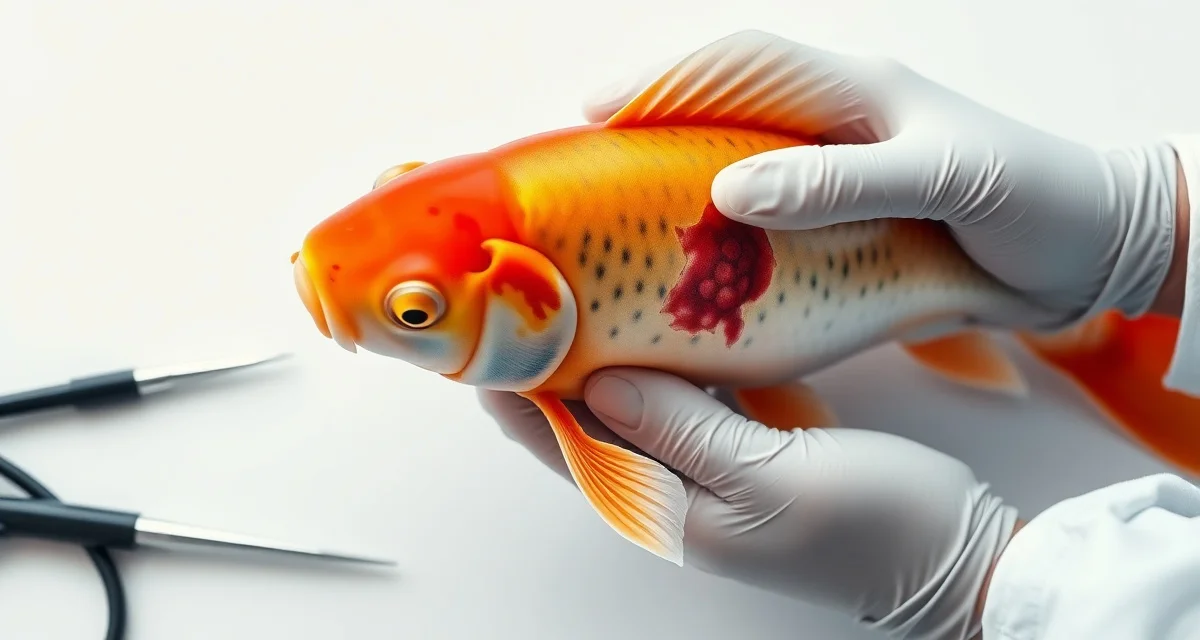
Koi Wounds and Lesions: Identification and Treatment
Secondary bacterial infection of koi wounds occurs in over 70% of untreated cases within 48 hours. Any wound or lesion on a koi's body requires prompt assessment and appropriate management, not a wait-and-see approach.
KoiQuanta's wound logging tracks lesion size and healing progress with photo comparison. No competitor supports wound tracking with photo documentation the way KoiQuanta does.
TL;DR
- Watch the wound closely for the first 48-72 hours for signs of infection developing.
- Salt at 0.3% inhibits Saprolegnia growth.
- When you photograph the wound at the same angle on day 1, day 5, and day 10, the photo comparison tells you objectively whether healing is progressing.
- Keep the fish out of water for no more than 30-60 seconds at a time.
- Seasonal changes require adjusted monitoring schedules; automated reminders help maintain consistency.
Identifying the Type of Wound or Lesion
The correct treatment depends on correctly identifying the type of wound or lesion. These are the main categories:
Bacterial Ulcers
Bacterial ulcers are the most serious category of koi skin lesion. They typically present as circular, open wounds with reddened edges, often with a slight central depression or crater appearance. The surrounding tissue may be reddened or hemorrhagic.
Common causes: Aeromonas hydrophila, Aeromonas salmonicida, Pseudomonas spp. These bacteria are present in virtually all koi ponds but only become pathogenic when koi immune function is compromised (by stress, poor koi pond water quality tracker, or other disease).
Treatment: Clean the wound with antiseptic solution (iodine, Betadine, or chlorhexidine) applied topically with a cotton swab. Apply an antibacterial topical (Orabase, neomycin ointment) to the wound. For severe ulcers or multiple affected fish, systemic antibiotics are appropriate if available. Improve water quality to support immune function. See the koi ulcer disease treatment guide for the full protocol.
Predator Wounds
Heron strikes produce distinctive long, narrow puncture wounds, often in the dorsal area or flanks. Cat claw marks produce parallel scratches. Raccoon attacks may cause larger tissue tears, typically from below on the ventral surface.
Distinguishing from bacterial ulcers: Predator wounds are acute (you'll often know the event occurred or find evidence), have irregular edges rather than the regular circular appearance of bacterial ulcers, and may have associated scale damage from the impact.
Treatment: Clean and disinfect the wound. Apply topical antibacterial to prevent secondary bacterial infection. Watch the wound closely for the first 48-72 hours for signs of infection developing. Add physical predator deterrents to prevent recurrence.
Spawning Injuries
Male koi chase females aggressively during spawning. The female can sustain significant physical damage: abraded scales, pressure marks, and skin damage from being pushed against hard surfaces.
Distinguishing features: Occurs specifically during spawning season (spring-early summer), affects female fish, damage pattern reflects physical pressure rather than infection, multiple areas of scale disruption without the characteristic ulcer appearance of bacterial disease.
Treatment: Similar to predator wounds: clean, disinfect, and prevent secondary infection. Separate the female from males if damage is severe. Most spawning injuries heal well with appropriate topical treatment and good water quality.
Parasitic Attachment Sites
Anchor worm (Lernaea) and fish louse (Argulus) leave characteristic attachment sites. Anchor worm creates a small wound where the parasite embeds, with the parasite visible as a white thread emerging from the skin. Fish louse creates small circular hemorrhagic spots where it attaches and feeds.
Treatment: Remove anchor worms with tweezers, rotating slightly as you pull to avoid breaking the parasite off in the wound. Treat the attachment site with antiseptic. The koi anchor worm treatment guide covers the full removal and post-removal treatment protocol. For fish louse, remove with tweezers and treat the pond with appropriate medication.
Fungal Infections
Saprolegnia fungal infections present as white to gray cotton-like growth emerging from wound sites. They're almost always secondary to an existing wound or immune compromise. The fungus colonizes damaged tissue rather than initiating infection in healthy fish.
Treatment: Treat the underlying wound and improve immune function (water quality, reduce stocking stress). Salt at 0.3% inhibits Saprolegnia growth. Malachite green topically at the infection site is effective but must be used carefully. The koi bacterial infection treatment guide also covers management of concurrent bacterial and fungal secondary infections.
Wound Assessment and Documentation
For any wound, document:
- Location on the body (describe precisely or use the diagram in KoiQuanta's wound logger)
- Size (measure if possible, or estimate in comparison to a known reference)
- Appearance (color of edges, depth, whether there's discharge)
- Photo from lateral view and close-up with scale reference
KoiQuanta's wound tracking feature creates a time-stamped record of each observation with attached photos. When you photograph the wound at the same angle on day 1, day 5, and day 10, the photo comparison tells you objectively whether healing is progressing.
Wounds that are increasing in size despite treatment require veterinary attention. Wounds that are stable or decreasing in size are responding appropriately.
Treating Koi Out of Water for Wound Care
Brief handling for wound treatment is necessary and manageable. Keep the fish out of water for no more than 30-60 seconds at a time. Work efficiently.
Wet your hands before handling. Apply topical treatment quickly. Return the fish to water and allow recovery before a second handling if necessary.
For wounds requiring more extensive topical treatment, a fish can be partially supported in a net with the treatment area just above water, allowing topical application without full removal. This is gentler than full removal and allows more time for application.
Frequently Asked Questions
How do I treat a wound on my koi?
First, identify the wound type. For bacterial ulcers, clean with a dilute antiseptic (Betadine, iodine) and apply an antibacterial topical such as neomycin ointment or orobase. For predator wounds, clean and disinfect the wound and apply topical antibacterial to prevent secondary bacterial infection. For spawning injuries, the approach is the same as predator wounds. For parasitic attachment sites, remove the parasite first, then treat the attachment wound. Maintain excellent water quality throughout treatment, as immune function is critical to wound healing. Log the wound in KoiQuanta with photos to track healing progress.
What is the difference between a bacterial ulcer and a predator wound?
Bacterial ulcers typically have regular, circular edges, a characteristic reddened rim, and often a depressed or sunken center. They develop over days, not overnight. Predator wounds have irregular edges reflecting the physical nature of the injury (puncture marks from a beak, scratches from claws), occur acutely, and may have associated scale disruption from the impact force. Predator wounds in healing can become bacterial ulcers if secondary bacterial infection isn't prevented. If you're uncertain about the origin, treat conservatively as if bacterial infection is a risk regardless of the initial cause.
Should I treat a koi wound topically or with bath treatment?
Both, in many cases. Topical treatment (directly to the wound during brief handling) is the most effective way to deliver high concentrations of antibacterial agents exactly where needed. Bath treatment (medicating the whole pond or quarantine tank) addresses the systemic bacterial challenge and prevents secondary infection through the water. For isolated wounds in otherwise healthy fish in good water quality, topical-only treatment is often sufficient. For multiple fish with wounds, rapidly spreading lesions, or water quality that's compromised, whole-pond or quarantine tank bath treatment is appropriate alongside topical care.
What is Koi Wounds and Lesions: Identification and Treatment?
Koi Wounds and Lesions: Identification and Treatment is a comprehensive guide to recognizing, categorizing, and treating skin injuries and lesions on koi fish. It covers bacterial ulcers, fungal infections, parasitic damage, and physical injuries. The guide emphasizes that over 70% of untreated wounds develop secondary bacterial infections within 48 hours, making prompt identification and action essential for fish survival and recovery.
How much does Koi Wounds and Lesions: Identification and Treatment cost?
This information is freely available as an educational resource on KoiQuanta. While the guide itself is free, KoiQuanta offers a wound logging and photo tracking tool that helps hobbyists monitor healing progress over time. Basic pond management features are available at no cost, with premium tools for systematic wound documentation and automated monitoring reminders available through KoiQuanta's platform.
How does Koi Wounds and Lesions: Identification and Treatment work?
Wound and lesion treatment works by first correctly identifying the wound type — bacterial ulcer, fungal lesion, or physical injury — then applying targeted treatment. Common steps include isolating the affected fish, applying topical antiseptics, maintaining salt at 0.3% to inhibit Saprolegnia growth, and monitoring closely for 48-72 hours. Treatment duration and method depend on wound severity and whether secondary infection has already developed.
What are the benefits of Koi Wounds and Lesions: Identification and Treatment?
Prompt treatment prevents secondary bacterial infection, which occurs in over 70% of untreated wounds within 48 hours. Early intervention reduces scarring, speeds recovery, and lowers mortality risk. Systematic photo documentation — taken at the same angle on day 1, day 5, and day 10 — removes guesswork by providing objective evidence of whether healing is progressing or deteriorating, allowing faster treatment adjustments.
Who needs Koi Wounds and Lesions: Identification and Treatment?
Any koi keeper with fish showing open wounds, ulcers, reddened patches, raised scales, or unusual skin lesions needs this guidance. Both beginner hobbyists and experienced pond keepers benefit, since wound assessment requires knowing specific visual indicators. Seasonal pond transitions create higher injury and infection risk, so keepers managing outdoor ponds year-round are particularly likely to encounter situations requiring structured wound identification and treatment.
How long does Koi Wounds and Lesions: Identification and Treatment take?
Initial wound assessment and treatment setup typically takes 15-30 minutes per fish. Healing timelines vary significantly: minor abrasions may resolve in 1-2 weeks, while deep bacterial ulcers can take 4-8 weeks of consistent treatment. Monitoring should occur daily for the first 72 hours, then every 2-3 days thereafter. Keeping fish out of water during treatment should not exceed 30-60 seconds per handling session.
What should I look for when choosing Koi Wounds and Lesions: Identification and Treatment?
Look for guides that distinguish between wound types rather than recommending one universal treatment. Prioritize resources that specify salt concentration, handling duration limits, and infection timelines backed by data. A good treatment framework includes photo-based progress tracking, not just subjective observation. KoiQuanta's wound logging with photo comparison provides objective healing documentation that most general koi care resources and competing platforms do not offer.
Is Koi Wounds and Lesions: Identification and Treatment worth it?
Yes, for any koi keeper who has invested in quality fish and a healthy pond ecosystem. A single untreated bacterial ulcer can become life-threatening within days and spread to other fish. The time cost of structured monitoring is minimal compared to fish loss. Using photo documentation and systematic logging removes uncertainty from the healing process and gives you actionable data — making it one of the highest-value practices in koi health management.
Sources
- Associated Koi Clubs of America (AKCA)
- Koi Organisation International (KOI)
- University of Florida IFAS Extension Aquaculture Program
- Fish Vet Group
- Water Quality Association