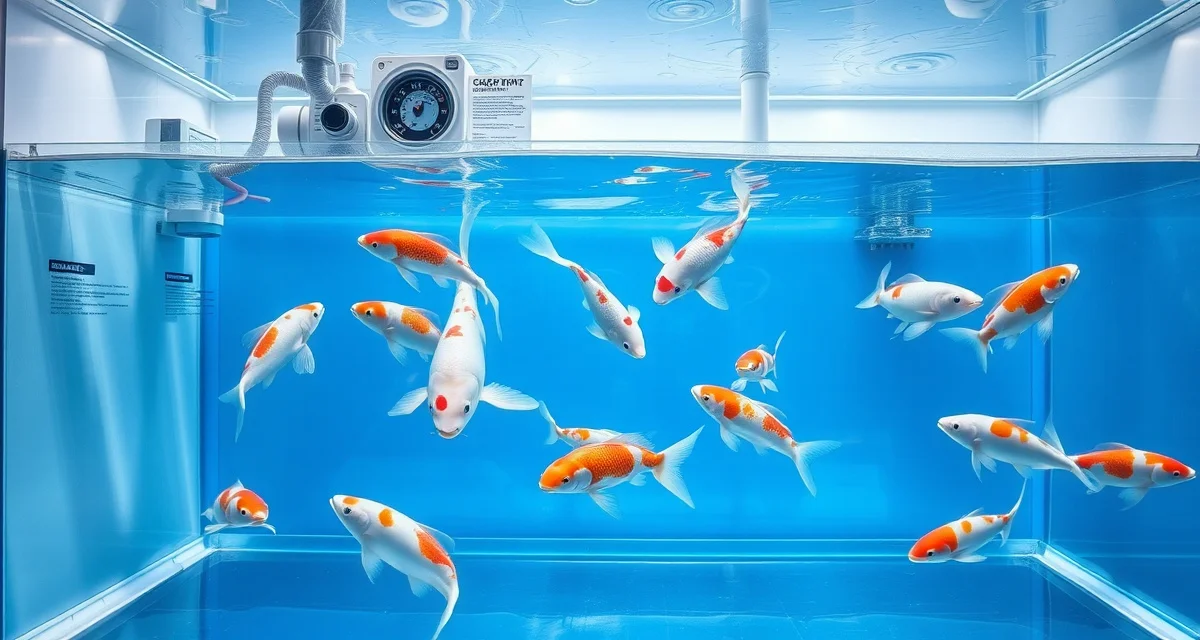
Koi Quarantine Best Practices: Lessons from Professional Breeders
Professional breeders who use systematic quarantine-best-medications) report mortality rates 70% lower than those who do not. This statistic comes from documented outcomes across professional koi facilities and represents what systematic, properly executed quarantine actually delivers when done consistently.
KoiQuanta's default protocols are based on established professional breeder practices. No competitor captures professional breeder quarantine standards and makes them accessible to hobbyists.
TL;DR
- These practices collectively produce the 70% lower mortality rate that systematic quarantine operations document compared to those without formal quarantine programs.
- A fish held for 4 weeks without observation and treatment isn't quarantined.
- KoiQuanta connects observations, water data, and treatment records in one searchable history.
- Early detection based on parameter trends reduces treatment costs and fish stress.
- Seasonal changes require adjusted monitoring schedules; automated reminders help maintain consistency.
Best Practice 1: Quarantine Every New Fish, Every Time
The most fundamental best practice is also the most frequently violated: quarantine applies to every new fish addition, without exception.
Professional breeders and dealers apply this rule universally because they understand what "looks healthy" actually means. A fish can be an immune carrier of KHV, a subclinical host for gill flukes at low load, or an asymptomatic reservoir of Aeromonas bacterial strains, and look entirely healthy at the time of purchase.
No exceptions for:
- Fish from trusted suppliers (suppliers can have problems too)
- Fish from other hobbyists' ponds (personal ponds can carry disease)
- Fish returned from shows (shows are very high disease risk events)
- Fish that were in quarantine "at the seller's facility" (their quarantine is not your quarantine)
- Small, cheap fish (low-value fish carry disease as effectively as high-value fish)
The dealer quarantine standards that professional operations follow apply this no-exceptions rule universally. Any inconsistency in application reduces the protection quarantine provides to near zero, because any single fish introduced without quarantine can infect an entire collection.
Best Practice 2: Separate Fish by Source
Never mix fish from different sources in the same quarantine container. Two fish from two different suppliers each carry their own pathogen history. Together in one quarantine tank, they cross-expose each other to pathogens they've never encountered, potentially creating disease that wouldn't have occurred if quarantined separately.
Professional breeders maintain dedicated quarantine bays for each incoming lot. The lot concept (all fish from one source at one time) is the basic unit of quarantine management.
KoiQuanta's quarantine module supports lot-based quarantine with separate profiles for each source lot, even if those lots are physically in separate sections of the same tank area.
Best Practice 3: Establish Quarantine Infrastructure Before You Need It
The worst time to set up a quarantine tank is when you have fish arriving in two days or when disease has already appeared in your display pond.
Professional facilities have quarantine infrastructure permanently ready: tanks cycled, heaters running, equipment maintained. When a shipment arrives, they receive it into a ready quarantine system.
Hobbyists should maintain their quarantine tank in a ready state year-round, not just set it up when a purchase is planned. This means:
- Filter media maintained with beneficial bacteria (add a small amount of ammonia weekly to keep bacteria active when the tank is empty)
- Heater running at minimum temperature
- Basic medications in stock with current expiry dates
Best Practice 4: Run a Complete Protocol, Not Just a Holding Period
A fish held in a quarantine tank for 4-6 weeks without active observation and management isn't quarantined. It's stored. Quarantine requires:
- Daily or every-other-day observation against a specific symptom checklist
- Water quality testing (minimum ammonia, nitrite, and pH every 2-3 days initially)
- Prophylactic antiparasitic treatment in the first 1-2 weeks (praziquantel for flukes, salt for protozoan parasites)
- Skin scrape investigation triggered by any behavioral signs
- Documented discharge criteria before fish move to the display pond
KoiQuanta's quarantine workflow provides all of these as structured steps. The protocol drives the observation, not your memory.
Best Practice 5: Temperature-Adjusted Treatment Timing
Treatment efficacy is temperature-dependent. Professional breeders adjust their quarantine protocols for seasonal temperature conditions:
- In summer (above 20°C): treat earlier in quarantine, observe more frequently, expect faster parasite reproduction requiring faster response
- In winter (below 15°C): heat quarantine tank to maintain treatment efficacy, extend quarantine duration because disease manifests more slowly in cold water
Most hobbyists run the same quarantine protocol year-round without these adjustments, which leads to under-treatment in summer and missed disease in winter.
Best Practice 6: Document Everything
Professional breeding operations keep complete records of every quarantine event: fish inventory, arrival date, source, daily observations, treatments, outcomes, and discharge. These records serve multiple functions:
- Disease tracing: When disease appears in the display pond, records identify which introduction event may have caused it
- Supplier quality tracking: Records show which suppliers have the highest disease incidence in arrivals
- Treatment outcome tracking: Records show which treatments work for your specific fish and pond conditions
- Compliance documentation: Required for dealers; valuable for hobbyists in insurance or sale contexts
KoiQuanta creates all of these records automatically as you follow the quarantine protocol. Documentation is a byproduct of good practice, not additional work.
Best Practice 7: Define Clear Discharge Criteria
A fish should not leave quarantine because "it's been long enough." It should leave quarantine because it has met specific criteria:
- Minimum quarantine period has elapsed (4 weeks at appropriate temperature)
- At least 14 symptom-free days at the end of quarantine (no disease signs in the final two weeks)
- All treatments are fully completed and fish have been off medication for at least 7 days
- Water quality has been stable and within safe parameters throughout
- Final observation confirms no signs present
KoiQuanta's discharge checklist codifies these criteria and requires confirmation of each before the quarantine is marked complete and discharge recommended. The koi quarantine discharge criteria page explains the rationale for each criterion.
Best Practice 8: Post-Quarantine Observation Period
After discharge into the display pond, experienced hobbyists continue elevated observation of new fish for 4-6 weeks. This isn't because quarantine failed; it's recognizing that the transition to a new environment (different water chemistry, different pond community, different pathogen exposure) can trigger disease from stress even in healthy fish.
During this post-quarantine observation window:
- Observe new fish at every feeding
- Watch for any stress signs or behavioral changes
- Note how existing fish respond to the newcomer
If disease appears in a new fish within 4 weeks of display pond introduction, isolate immediately and investigate. This is the post-quarantine safety net.
Frequently Asked Questions
What quarantine practices do professional koi breeders use?
Professional koi breeders apply quarantine universally (no exceptions), separate fish strictly by source lot (never mixing fish from different sources in one quarantine system), maintain ready quarantine infrastructure year-round, run complete observation and treatment protocols rather than just holding periods, adjust for seasonal temperature changes, document every quarantine event completely, use specific discharge criteria rather than time-only rules, and continue elevated observation after discharge into the display pond. These practices collectively produce the 70% lower mortality rate that systematic quarantine operations document compared to those without formal quarantine programs.
How is professional koi quarantine different from hobbyist quarantine?
Professional operations apply the practices consistently and without exceptions, while hobbyists often make exceptions for "trusted" sources, skip prophylactic treatments occasionally, or end quarantine early when fish look good. The infrastructure is typically more developed (dedicated quarantine bays, purpose-built systems), documentation is systematic and complete, and protocols are adjusted for seasonal temperature conditions. The good news for hobbyists is that KoiQuanta makes professional-grade systematic quarantine accessible: the same protocols, the same documentation structure, and the same discharge criteria that professional facilities use are built into KoiQuanta's quarantine module.
What can hobbyists learn from dealer quarantine standards?
The most important lesson from professional quarantine is the no-exceptions rule: every fish, every time, regardless of source, appearance, or value. Hobbyists lose fish most often through the exceptions they make. The second lesson is that quarantine is a protocol with specific steps and discharge criteria, not a holding period with a time limit. A fish held for 4 weeks without observation and treatment isn't quarantined. The third lesson is documentation: keeping complete records of every quarantine event creates the data that improves future outcomes by identifying which sources, seasons, and conditions are associated with disease risk.
What is Koi Quarantine Best Practices: Lessons from Professional Breeders?
This article compiles quarantine protocols used by professional koi breeders and translates them into actionable practices for hobbyists. It covers why quarantine must be applied to every new fish without exception, how to monitor water parameters and fish behavior during isolation, and how connecting observations with treatment records produces documented outcomes — including mortality rates 70% lower than operations without formal quarantine programs.
How much does Koi Quarantine Best Practices: Lessons from Professional Breeders cost?
The article itself is free educational content on KoiQuanta. The practices described require basic quarantine infrastructure — a separate tank, aeration, and water testing equipment — which varies in cost. KoiQuanta's tracking tools, which help you connect observations, water data, and treatment records into a searchable history, are available on the platform. Check KoiQuanta.com for current pricing on any premium features.
How does Koi Quarantine Best Practices: Lessons from Professional Breeders work?
The protocols work by enforcing isolation of every new fish before it contacts your main pond, then systematically observing behavior, tracking water parameters, and applying treatments as needed over a minimum four-week period. KoiQuanta supports this by linking your observations, parameter readings, and medication records in one place, enabling early detection of problems based on trends rather than waiting for visible symptoms.
What are the benefits of Koi Quarantine Best Practices: Lessons from Professional Breeders?
Systematic quarantine produces measurably better outcomes: professional facilities following these protocols document mortality rates approximately 70% lower than those without formal programs. Additional benefits include reduced treatment costs through early detection, less fish stress, protection of your existing collection from introduced pathogens, and a searchable health history that helps you make better decisions over time.
Who needs Koi Quarantine Best Practices: Lessons from Professional Breeders?
Any koi keeper adding new fish to an established pond benefits from these practices. They are especially important for hobbyists who source fish from multiple suppliers, attend auctions, or receive fish as gifts — all high-risk introduction scenarios. Breeders managing multiple systems and anyone who has experienced unexplained losses after adding new fish will find the structured approach particularly valuable.
How long does Koi Quarantine Best Practices: Lessons from Professional Breeders take?
A minimum four-week quarantine period is the professional standard. A fish held for four weeks without active observation and treatment does not meet that standard — the duration requires consistent monitoring. Seasonal factors matter too: temperature changes affect fish immunity and disease progression, so monitoring schedules should be adjusted accordingly. KoiQuanta's automated reminders help maintain consistency across seasonal transitions.
What should I look for when choosing Koi Quarantine Best Practices: Lessons from Professional Breeders?
Look for protocols grounded in documented professional outcomes rather than hobbyist convention. Key elements include no-exceptions quarantine policies, parameter-based early detection, integrated observation and treatment logging, and guidance on seasonal adjustments. Platforms that connect water data, behavioral notes, and medication records in a single searchable history are more reliable than managing these separately in spreadsheets or memory.
Is Koi Quarantine Best Practices: Lessons from Professional Breeders worth it?
Yes, if you keep koi. The 70% reduction in mortality documented by systematic quarantine operations represents real fish and real money. Early detection alone reduces treatment costs and fish stress significantly. The investment in a proper quarantine setup and a structured tracking system pays back quickly compared to the cost of losing established fish to an introduced pathogen that a four-week quarantine would have caught.
Related Articles
Sources
- Associated Koi Clubs of America (AKCA)
- Koi Organisation International (KOI)
- University of Florida IFAS Extension Aquaculture Program
- Fish Vet Group
- Water Quality Association