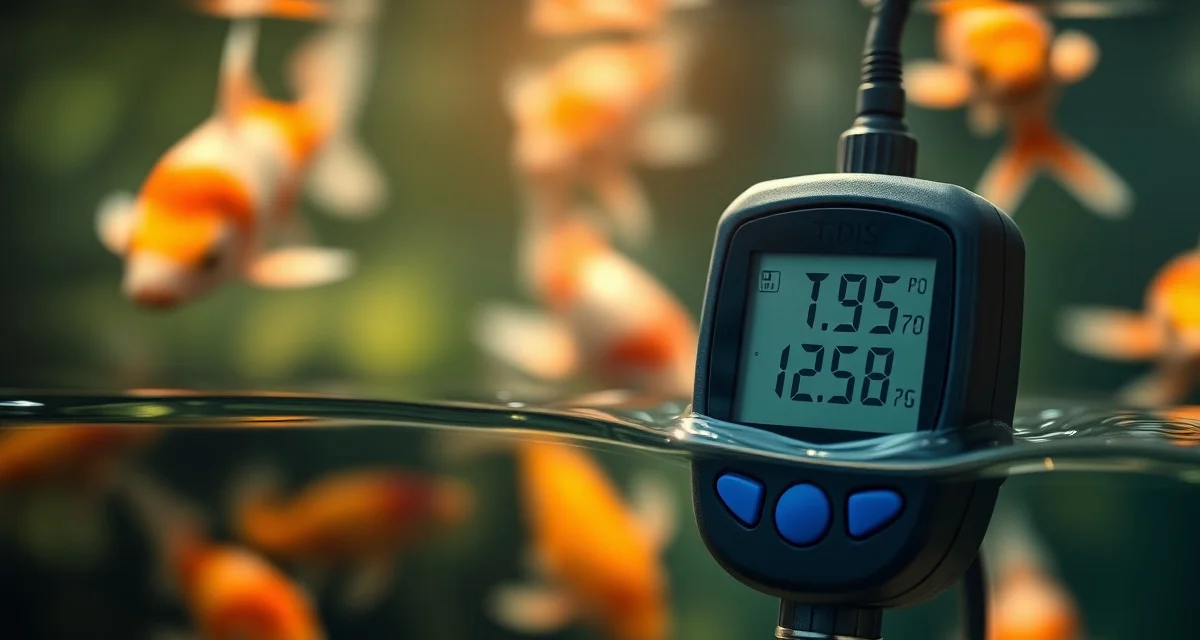
Total Dissolved Solids in Koi Ponds: What TDS Tells You
A sudden TDS spike without a corresponding water addition event indicates organic decomposition or chemical release in the pond. This is the real value of tracking TDS in a koi pond: it's a rapid screening tool that catches chemistry changes before you've had a chance to test individual parameters, or even before individual parameters have reached dangerous levels.
TDS doesn't tell you what changed. But it tells you that something changed, prompting a full parameter check before a problem becomes a crisis.
TL;DR
- A spike of 50+ ppm over 24-48 hours suggests either organic matter release from sediment disturbance, a large organic decomposition event (dead fish, dying plants), or an unknown chemical release.
- Full parameter testing (pH, ammonia, nitrite, nitrate, alkalinity, dissolved oxygen, plus secondary parameters) takes 30-45 minutes and costs several dollars in reagents each time.
- TDS testing with a meter takes 10 seconds and costs essentially nothing after the initial meter purchase (meters typically cost $15-40).
- At 0.3% therapeutic salt dose calculator, TDS rises by approximately 1,600 ppm, a dramatic increase that your meter will detect immediately.
- For most koi ponds without salt in moderately hard water areas, 150-400 ppm is typical.
What TDS Measures
Total dissolved solids (TDS) is a measurement of all dissolved substances in water: minerals, salts, metals, organic compounds, and anything else that passes through a fine filter and remains in solution. It's measured in parts per million (ppm) or milligrams per liter (mg/L), which are equivalent.
In a koi pond, TDS includes:
- Calcium and magnesium (hardness minerals)
- Sodium, potassium
- Chlorides, sulfates
- Dissolved ammonia, nitrite, nitrate
- Dissolved organic compounds from fish waste and food
- Treatment chemicals added to the pond
- Salt (if maintained)
- Any other ions in solution
A TDS meter, an inexpensive electronic device, reads all of these combined as a single number. It takes two seconds, costs almost nothing per test, and gives you a snapshot of your pond's chemistry load relative to its baseline.
Baseline TDS for Koi Ponds
There's no universal "correct" TDS for a koi pond because the right level depends on your source water, mineral content, and management practices.
Typical ranges:
- Ponds without salt: 150-400 ppm (depending on source water hardness)
- Ponds maintained with 0.1% salt: 600-900 ppm (salt contributes approximately 533 ppm per 0.1%)
- Very soft water regions: may be below 100 ppm without intervention
- Very hard water regions: may be 400-600 ppm in normal operation
What matters is not the absolute number but your baseline and any deviations from it. Establish your normal TDS range by measuring at the same time each week over several months. Then track deviations from that baseline.
What TDS Changes Tell You
Gradually rising TDS without water additions indicates accumulation of dissolved substances from fish waste, organic decomposition, or salt concentration through evaporation. This is normal to some degree. It's what water changes address. A slow upward trend signals that water changes are needed.
Suddenly rising TDS without a clear input (water addition, new treatment, salt addition) is the alert signal. A spike of 50+ ppm over 24-48 hours suggests either organic matter release from sediment disturbance, a large organic decomposition event (dead fish, dying plants), or an unknown chemical release. Pull out the full test kit immediately.
Falling TDS typically means dilution from rainfall or water additions, loss of salt through substrate adsorption, or biological uptake of minerals. Unexpected TDS drops are less common but worth investigating.
Stable TDS during stable management indicates your pond chemistry is in equilibrium, which is the most desirable state.
TDS as a Low-Cost Daily Screening Tool
The most valuable use of TDS monitoring is its speed and cost compared to full parameter testing.
Full parameter testing (pH, ammonia, nitrite, nitrate, alkalinity, dissolved oxygen, plus secondary parameters) takes 30-45 minutes and costs several dollars in reagents each time. TDS testing with a meter takes 10 seconds and costs essentially nothing after the initial meter purchase (meters typically cost $15-40).
KoiQuanta's TDS trend monitoring provides a daily low-cost snapshot that flags when full multi-parameter testing should be triggered. Rather than full testing every day (impractical for most hobbyists), TDS can be measured daily and a spike or drop triggers the full test battery. This gives you daily surveillance resolution at a fraction of the time and cost.
KoiQuanta TDS Tracking
KoiQuanta adds TDS as a rapid screening tool that flags when full parameter testing is warranted. When you log daily TDS readings, KoiQuanta compares each reading against your established baseline and flags deviations beyond your personal normal range. A flag means test more thoroughly today, not necessarily that there's an emergency.
Your KoiQuanta koi pond water quality guide data provides the individual parameter context that explains what TDS is indicating. The koi water quality calculator tools help you interpret what those parameter readings mean for fish health.
TDS and Salt Management
Salt is one of the highest-TDS-contribution additives you'll use in a koi pond. At 0.3% therapeutic salt treatment, TDS rises by approximately 1,600 ppm, a dramatic increase that your meter will detect immediately.
This makes TDS useful for:
- Confirming salt has been distributed evenly through the pond after addition
- Tracking salt concentration over time as evaporation and water changes affect levels
- Detecting salt concentration creep in ponds maintained with permanent low salt
TDS Meter Selection and Use
Selecting a TDS meter:
- Any brand-name TDS/EC meter works for pond monitoring
- Resolution to 1 ppm is adequate; 0.1 ppm resolution is unnecessary for this application
- Temperature compensation is useful (TDS readings vary with temperature)
- Calibration with known reference solution every few months ensures accuracy
Using the meter correctly:
- Rinse the electrode with distilled water before and after each test
- Measure at a consistent depth and location in the pond
- Record the temperature alongside TDS if your meter shows temperature, as it affects interpretation
- Calibrate periodically with a reference solution
Frequently Asked Questions
What is a good TDS level for a koi pond?
There's no single correct TDS level. The right range depends on your source water mineral content, whether you maintain salt, and your specific management practices. What matters is your personal baseline, established by measuring regularly over several weeks without major inputs. For most koi ponds without salt in moderately hard water areas, 150-400 ppm is typical. Ponds with therapeutic or maintenance-level salt run higher. The goal is stability within your established range, with deviations from baseline prompting further investigation.
Does high TDS harm koi?
Very high TDS (above 1,500-2,000 ppm without salt additions) can start to affect osmoregulation, but this level is rarely reached in normal koi pond management. High TDS from salt is a managed therapeutic choice, not an accidental contamination. The primary concern with rising TDS is not the TDS itself but what's causing it: accumulating organic waste, treatment chemical buildup, or unknown chemical release. TDS alerts you to investigate the cause, not because the number itself is necessarily the problem.
Can I use TDS to monitor koi pond water quality?
Yes, as a rapid screening tool but not as a replacement for individual parameter testing. TDS gives you a combined picture of dissolved chemistry that detects changes quickly and inexpensively. When TDS is stable and within your established baseline, it confirms your pond chemistry is in equilibrium and full parameter testing can proceed at your normal schedule. When TDS spikes or drops unexpectedly, it signals that something has changed and individual parameter testing is warranted immediately. Used this way, daily TDS monitoring provides surveillance-level oversight between your regular full water tests.
What is Total Dissolved Solids in Koi Ponds: What TDS Tells You?
Total Dissolved Solids (TDS) in a koi pond refers to the combined concentration of all dissolved substances in the water, including minerals, salts, organic compounds, and chemicals. Measured in parts per million (ppm), TDS gives you a single number that reflects your pond's overall water chemistry. For most koi ponds in moderately hard water without added salt, a healthy TDS range is 150–400 ppm. Sudden changes in TDS signal that something in your pond chemistry has shifted, even before individual parameters reach dangerous levels.
How much does Total Dissolved Solids in Koi Ponds: What TDS Tells You cost?
Monitoring TDS in your koi pond is extremely affordable. A quality TDS meter costs between $15 and $40 as a one-time purchase. After that, each individual test costs essentially nothing — no reagents, no test strips, no consumables. Compare that to a full parameter test (pH, ammonia, nitrite, nitrate, alkalinity, dissolved oxygen) which takes 30–45 minutes and costs several dollars in reagents every time. TDS testing is one of the most cost-effective tools in a koi keeper's toolkit.
How does Total Dissolved Solids in Koi Ponds: What TDS Tells You work?
A TDS meter works by passing a small electrical current between two probes submerged in pond water. Dissolved ions conduct electricity, so the meter measures electrical conductivity and converts it to a ppm reading. The more dissolved substances in the water, the higher the conductivity and the higher the TDS reading. The entire process takes about 10 seconds. While TDS doesn't identify which specific substances are present, it reliably detects when overall water chemistry has changed.
What are the benefits of Total Dissolved Solids in Koi Ponds: What TDS Tells You?
TDS monitoring acts as a rapid early-warning system for your koi pond. A spike of 50+ ppm over 24–48 hours can indicate organic decomposition, sediment disturbance, a dead fish, dying plants, or an unknown chemical release — all before individual parameters reach crisis levels. It also instantly confirms therapeutic salt doses (a 0.3% salt treatment raises TDS by approximately 1,600 ppm), tracks mineral buildup over time, and helps you decide when a full parameter test is warranted without wasting reagents unnecessarily.
Who needs Total Dissolved Solids in Koi Ponds: What TDS Tells You?
Any koi pond owner benefits from tracking TDS, but it's especially valuable for keepers managing larger or heavily stocked ponds where water quality events can escalate quickly. Hobbyists who don't test water daily will find TDS an efficient triage tool. Pond owners using therapeutic salt treatments need it to verify dosing accuracy. Anyone troubleshooting unexplained fish behavior, lethargy, or surface gasping should check TDS immediately as a first screening step before committing to a full parameter test.
How long does Total Dissolved Solids in Koi Ponds: What TDS Tells You take?
Taking a TDS reading requires about 10 seconds — simply dip the meter probes into the pond water and read the display. The real time investment is in establishing a baseline and tracking trends over days and weeks. Once you know your pond's normal TDS range, any significant deviation is immediately apparent. Logging readings takes less than a minute. By contrast, a full water chemistry panel takes 30–45 minutes, making TDS the faster first filter for deciding whether deeper investigation is needed.
What should I look for when choosing Total Dissolved Solids in Koi Ponds: What TDS Tells You?
Look for a TDS meter with a range of at least 0–1,999 ppm to cover normal pond conditions and salt-treated water. Temperature compensation (often labeled ATC) improves accuracy across seasonal changes. A waterproof or water-resistant housing is important for pond-side use. Calibration capability ensures long-term accuracy — check that replacement calibration solution is available. Dual TDS/EC meters offer additional value. Avoid meters without a stated accuracy specification. Brands like HM Digital and Apera are well-regarded in the aquatic hobby community.
Is Total Dissolved Solids in Koi Ponds: What TDS Tells You worth it?
Yes — a TDS meter is one of the best value purchases a koi keeper can make. At $15–40, it pays for itself quickly by reducing unnecessary full parameter tests. More importantly, it catches water chemistry changes in seconds, giving you time to investigate and act before fish are stressed or killed. TDS won't replace full parameter testing, but it dramatically improves how efficiently you use those tests. For early detection of decomposition events, salt dosing verification, and daily pond health screening, TDS monitoring is genuinely worth it.
Related Articles
Sources
- Associated Koi Clubs of America (AKCA)
- Koi Organisation International (KOI)
- University of Florida IFAS Extension Aquaculture Program
- Fish Vet Group
- Water Quality Association