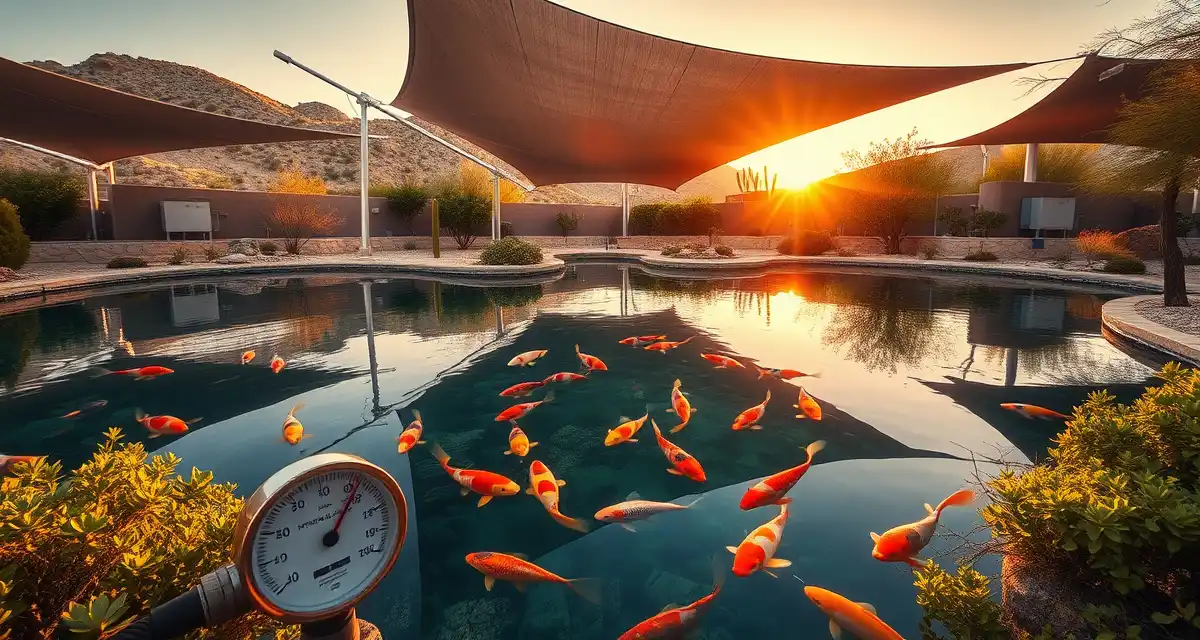
Koi Keeping in Arizona: Extreme Heat Survival
Arizona summer water temperatures can exceed 40°C without intervention -- lethal to koi. This is not a warning about edge cases. In the Phoenix metro area, air temperatures regularly hit 43-46°C for weeks at a time in July and August. A pond in full sun will track air temperature with a 3-6 hour lag. Without active cooling, a Phoenix pond can genuinely reach temperatures where koi die from heat stress alone.
Keeping koi in Arizona is possible -- many Arizona hobbyists do it successfully -- but it requires a fundamentally different level of heat management than any other US climate.
TL;DR
- In the Phoenix metro area, air temperatures regularly hit 43-46°C for weeks at a time in July and August.
- A pond in full sun will track air temperature with a 3-6 hour lag.
- At 30°C, water holds about 7.5 mg/L at saturation.
- At 40°C, it's approaching 6.5 mg/L -- and your koi's oxygen demand is actually higher at warmer temperatures because their metabolism is running faster.
- KoiQuanta's Arizona profiles flag dissolved oxygen alerts at lower temperature thresholds than standard defaults, because the margin between safe and critical is compressed when you're starting at 35°C.
- An ammonia reading that would be manageable at 20°C becomes genuinely dangerous at 35°C.
- The key requirements for Arizona koi survival: 1.
Why Arizona Is the Hardest US Climate for Koi
Dissolved oxygen saturation drops with rising temperature. At 30°C, water holds about 7.5 mg/L at saturation. At 35°C, that drops to about 7.0 mg/L. At 40°C, it's approaching 6.5 mg/L -- and your koi's oxygen demand is actually higher at warmer temperatures because their metabolism is running faster.
KoiQuanta's Arizona profiles flag dissolved oxygen alerts at lower temperature thresholds than standard defaults, because the margin between safe and critical is compressed when you're starting at 35°C.
Add to this: at high temperatures, ammonia toxicity increases dramatically. The ionized/unionized ammonia equilibrium shifts toward the more toxic unionized form at higher temperatures and higher pH. An ammonia reading that would be manageable at 20°C becomes genuinely dangerous at 35°C.
Then add the compounding factor of high evaporation -- Arizona's dry heat evaporates pond water rapidly, concentrating dissolved solids and potentially affecting chemistry.
Can Koi Survive Arizona Summers?
Yes, with the right setup. But the setup is non-trivial and requires real investment.
The key requirements for Arizona koi survival:
- Adequate shade (50-70% of surface area minimum)
- Active cooling (evaporative, fans, or refrigeration-based)
- Maximum continuous aeration
- Deep pond (1.5-2m minimum)
- Vigilant dissolved oxygen monitoring
Without all five of these, summer koi survival in Phoenix-area ponds is genuinely at risk.
Shade Management: The Foundation
Nothing is more important than shade in Arizona. A fully shaded pond stays dramatically cooler than an unshaded one. Shade cloth at 50-70% density over the full pond surface is the baseline for most Arizona ponds.
Options:
Shade cloth structures: Purpose-built frames with shade cloth (40-70% density) over the pond are cost-effective and can be designed for your specific pond dimensions. Removable in winter.
Pergolas and patios: If you can position your pond under an existing shaded structure, you're starting from a much better position. Many Arizona koi enthusiasts build ponds in covered patio areas.
Aquatic plants: Water hyacinth, water lettuce, and lotus provide surface shading and also cool through evapotranspiration. In Arizona, floating plants that might struggle in northern climates grow explosively in summer. They also take up nitrate, helping koi pond water quality tracker.
What shade structures work for Arizona koi ponds? Aluminum framed structures with shade cloth are the most common purpose-built solution. These can be permanent or seasonal -- many Arizona keepers put them up in April and take them down in October.
Evaporative Cooling in Arizona's Dry Climate
Arizona's low humidity is your best ally for evaporative cooling. Evaporative cooling efficiency is dramatically better in dry air than in humid air -- which is why Texas feels worse at 38°C than Phoenix, even though Phoenix is hotter.
Fountains and waterfalls: Moving water evaporates far faster than still water. A vigorous waterfall or multiple fountains can reduce pond temperature by 3-5°C through evaporation in dry Arizona air. Run these continuously.
Misting systems: In dry climates, misting systems above the pond can provide meaningful cooling through evaporation. The mist evaporates before it reaches the water in low-humidity conditions, cooling the air above the pond.
Mechanical fans: A large fan blowing across the pond surface increases evaporation rate. Not glamorous, but effective.
Evaporation replenishment: All this evaporation means you'll add considerable water volume to maintain pond level. In peak Arizona summer, a pond may lose 1-3% of its volume per day to evaporation. Top up with dechlorinated water, and be aware that evaporation concentrates dissolved solids -- monitor TDS (total dissolved solids) or hardness as a proxy if you're adding large volumes of hard tap water over time.
Refrigeration Cooling: The Definitive Solution
For ponds with valuable fish, a refrigeration-based pond chiller is the only truly reliable way to maintain safe temperatures in Arizona. These units function like an air conditioner for your pond -- they pump pond water through a heat exchanger that removes heat before returning the cooled water.
Sizing is critical and often underestimated. Aquaculture chillers are rated by cooling capacity (BTUs or tons of refrigeration). For an Arizona pond in direct summer sun, most sizing calculators need to be doubled because of the extreme heat load. Get professional advice on sizing if you're investing in a chiller.
Chillers run continuously through summer, which carries a real operating cost. Factor this into your decision about whether koi keeping in Arizona is the right commitment for you.
For broader guidance on hot-climate oxygen management, the koi dissolved oxygen guide covers oxygen monitoring and supplementation strategies applicable to extreme heat conditions.
Dissolved Oxygen Management
Run every aerator at full capacity from May through September. This isn't negotiable in Arizona summers. Your oxygen management stack might include:
- Main filtration return with surface agitation
- Multiple air pumps with air stones
- Fountain(s)
- Waterfall or cascade
If you have any concern that dissolved oxygen is dropping, measure it. Test kits give you a point-in-time reading; a continuous DO meter gives you real-time monitoring that catches drops before they become emergencies.
For emergency response if oxygen drops to critical levels, the koi oxygen depletion emergency guide covers immediate actions.
Arizona Water Chemistry Considerations
Phoenix-area water is typically very hard and alkaline. High KH means good pH buffering -- not the pH crash risk of Pacific Northwest rain-diluted water. The primary Arizona chemistry concerns are:
High pH (8.0-8.5 or higher): Common in hard Arizona water. At high pH, ammonia toxicity is elevated. Keep feeding rates conservative in peak summer heat when both temperature and pH work against you.
Evaporative concentration: As pond water evaporates and is replaced with tap water, dissolved minerals can accumulate over time. Regular partial water changes (which also help cool the pond) prevent this concentration from becoming a problem.
Calcium and scale: Hard Arizona water can deposit calcium on pond equipment. This is a maintenance consideration but not a fish health issue.
Seasonal Calendar for Arizona Koi
October through March: The excellent season. Mild temperatures, active koi, peak growing season. Normal management -- good food, regular water changes, standard monitoring.
April: Begin heat preparation. Shade structures up. Evaporative cooling systems running. Feeding rate moderate.
May through September: Full heat management mode. Maximum shade, maximum aeration, possibly chiller running. Reduce feeding to once daily. Monitor DO continuously or daily. Water changes to cool and dilute.
September through October: Temperatures moderate. Ramp up feeding to rebuild fish condition lost during summer stress.
Frequently Asked Questions
How do I cool my koi pond in Arizona?
The most effective approach combines multiple strategies: shade 50-70% of the pond surface with shade cloth or structures, run fountains and waterfalls continuously for evaporative cooling (Arizona's dry air makes this very effective), maximize aeration, and maintain pond depth of at least 1.5m for thermal mass. For ponds with valuable fish, a refrigeration-based pond chiller is the definitive solution. KoiQuanta's Arizona profile sets lower dissolved oxygen alert thresholds and provides summer heat management checklists.
Can koi survive Arizona summers?
Yes, with the right setup. Many Arizona hobbyists successfully keep koi through Phoenix-area summers. The requirements are: adequate shade, active evaporative cooling or mechanical chilling, maximum aeration, and a deep pond with good thermal mass. Without all of these, summer mortality risk is real -- Arizona summer water temperatures can exceed 40°C without intervention, which is lethal. The investment in proper heat management is the cost of entry for koi keeping in Arizona.
What shade structures work for Arizona koi ponds?
Aluminum-framed shade structures with 50-70% density shade cloth are the most common purpose-built solution -- they're inexpensive relative to their effectiveness, can be installed over any pond, and are removable for winter when shade isn't needed. Covered patio areas and pergolas work well if you can position your pond under existing structures. Floating aquatic plants (water hyacinth, lotus) provide surface shading while also taking up nutrients and cooling through evapotranspiration. A combination of structural shade and floating plants typically outperforms either alone.
What is Koi Keeping in Arizona: Extreme Heat Survival?
Koi Keeping in Arizona: Extreme Heat Survival is a practical guide for hobbyists managing koi ponds in one of the harshest climates in the US. Phoenix metro summers regularly hit 43-46°C, pushing unshaded ponds to lethal water temperatures above 40°C. The guide covers active cooling strategies, oxygen management, filtration adjustments, and how tools like KoiQuanta's Arizona-specific profiles help you monitor dissolved oxygen and ammonia thresholds calibrated for high-heat conditions — not the standard defaults built for cooler climates.
How much does Koi Keeping in Arizona: Extreme Heat Survival cost?
There is no direct cost to the survival strategies outlined here — shade structures, chillers, and aeration equipment vary widely in price depending on pond size and existing setup. A quality pond chiller for a mid-sized pond typically runs $500–$2,000. Shade cloth and misters are far cheaper. KoiQuanta offers monitoring profiles with Arizona-specific alert thresholds; check koiquanta.com for current pricing on software plans that include regional heat management features.
How does Koi Keeping in Arizona: Extreme Heat Survival work?
Arizona koi survival works by attacking the heat problem from multiple angles simultaneously. Shade reduces solar gain before it enters the water. Chillers or evaporative cooling actively lower water temperature. Aeration and surface agitation maintain dissolved oxygen, which drops sharply above 30°C. KoiQuanta's Arizona profiles flag dissolved oxygen and ammonia alerts earlier than standard defaults, giving you a compressed warning window that accounts for how quickly conditions deteriorate when your baseline is already 35°C.
What are the benefits of Koi Keeping in Arizona: Extreme Heat Survival?
The core benefit is keeping fish alive that would otherwise die. Beyond survival, proper heat management means better water quality, lower stress on your koi's immune system, reduced ammonia toxicity risk, and more stable pond chemistry year-round. Arizona hobbyists who invest in active cooling report healthier fish, better growth rates, and far fewer emergency losses during peak summer months. It also makes pond keeping genuinely enjoyable rather than a season-long crisis management exercise.
Who needs Koi Keeping in Arizona: Extreme Heat Survival?
Anyone keeping or planning to keep koi in Arizona, particularly in the Phoenix, Tucson, or Yuma metro areas, needs this level of heat management. It is equally relevant to hobbyists in other desert Southwest climates including parts of Nevada, New Mexico, and West Texas. If your summer air temperatures routinely exceed 40°C and your pond receives significant direct sun, standard koi keeping advice built around temperate climates does not apply — you need Arizona-specific protocols.
How long does Koi Keeping in Arizona: Extreme Heat Survival take?
Active heat management is not a one-time setup — it runs continuously from roughly May through September in Phoenix, with July and August being the critical window. Installing shade and aeration can be done in a single weekend. A pond chiller takes hours to plumb in. Ongoing daily monitoring, especially of dissolved oxygen and ammonia, is the actual time commitment: plan for 10–15 minutes of observation per day during peak heat to catch problems before they become losses.
What should I look for when choosing Koi Keeping in Arizona: Extreme Heat Survival?
Prioritize active cooling capacity first — shade alone is rarely sufficient for Phoenix summers. Look for a chiller rated above your pond's actual volume to account for ambient heat load. Aeration should be redundant: if one pump fails overnight, your fish should not die before morning. Choose monitoring tools with region-specific alert thresholds; generic koi software calibrated for temperate climates will miss critical warning signs in Arizona conditions. KoiQuanta's Arizona profiles are built specifically for this compressed safety margin.
Is Koi Keeping in Arizona: Extreme Heat Survival worth it?
For serious hobbyists in Arizona, yes — unambiguously. The alternative is losing expensive fish every summer, which negates any savings from skipping equipment. Koi can live 20–30 years and reach significant value; protecting that investment with a chiller and proper monitoring is straightforward math. Beyond cost, there is real satisfaction in mastering a difficult climate. Many Arizona koi keepers run some of the most technically sophisticated backyard ponds in the country precisely because the challenge demanded it.
Related Articles
Sources
- Associated Koi Clubs of America (AKCA)
- Koi Organisation International (KOI)
- University of Florida IFAS Extension Aquaculture Program
- Fish Vet Group
- Water Quality Association