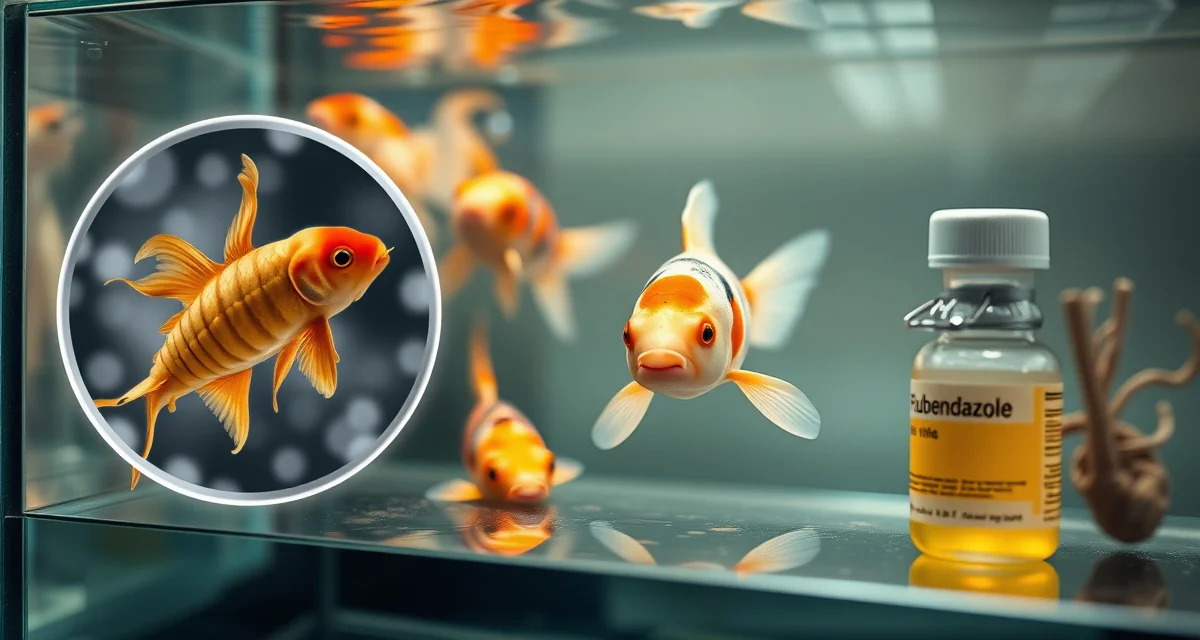
Flubendazole Treatment for Koi: Parasite Protocol
Rotating antiparasitic medications helps prevent resistance development in koi parasites. This is the key reason flubendazole deserves a place in your parasite management toolkit even if you primarily use Praziquantel for flukes. When you always treat with the same medication, you select for the subset of parasites that are less susceptible to that drug -- and resistance builds over time in your fish population.
Flubendazole works through a completely different mechanism than Praziquantel, making it an effective rotation partner.
TL;DR
- Flubendazole works more gradually over 24-48 hours.
- At 0.2 mg/L, you have a more aggressive treatment for confirmed heavy infestations.
- For a 1,000-liter (265-gallon) pond: 0.1-0.2 grams of pure flubendazole, or the equivalent in your commercial product based on its stated concentration.
- UV exposure reduces potency over longer periods, but for the 3-7 day treatment window, degradation is not typically a problem.
- Temperature affects treatment efficacy -- warmer water (18-22°C) produces better results than cold water (below 12°C).
- For a 1,000-liter pond, that's 0.1-0.2 grams of active ingredient.
- Repeat 7-10 days later to catch flukes that hatched from eggs after the initial treatment.
What Flubendazole Treats
Flubendazole is a benzimidazole anthelmintic -- the same drug class used in veterinary and human medicine for worm treatment. In koi, it's effective against:
- Monogenean flukes: Both Gyrodactylus (skin flukes) and Dactylogyrus (gill flukes)
- Anchor worm: Effective against larval and early adult stages of Lernaea
- Fish lice (Argulus): Some efficacy against juvenile stages
It is not effective against protozoan parasites (trichodina, ich, costia, velvet) or bacterial infections.
KoiQuanta's medication log tracks which antiparasitic was used for each treatment event, which enables resistance pattern monitoring over time. If you see reduced efficacy from a specific medication in your logs, that's a signal to rotate to a different drug class.
How Flubendazole Compares to Praziquantel for Flukes
Both medications are effective against monogenean flukes, but they differ in several practical ways:
Mechanism: Praziquantel disrupts the flukes' neuromuscular system causing paralysis. Flubendazole inhibits tubulin polymerization, disrupting cell division and metabolism. Different mechanisms mean no cross-resistance -- if flukes develop reduced sensitivity to Praziquantel, flubendazole remains effective and vice versa.
Speed of action: Praziquantel typically acts faster, with visible fluke detachment occurring within hours. Flubendazole works more gradually over 24-48 hours.
Residual effect: Flubendazole has a longer residual activity in the water than Praziquantel, which provides some continued protection against newly hatched juveniles.
Stability: Flubendazole is relatively stable in pond water and is not greatly affected by UV or organic load degradation in the short treatment window. Praziquantel degrades faster in UV-exposed pond water, which is one reason pond treatments sometimes require higher doses than tank treatments.
Plant safety: Both are generally considered safe for aquatic plants at recommended treatment concentrations, though individual sensitivities can vary.
Dosing Flubendazole for Koi
Standard pond treatment: 0.1-0.2 mg/L (parts per million)
At 0.1 mg/L, this is a conservative starting dose appropriate for initial treatments or fish that may be sensitized. At 0.2 mg/L, you have a more aggressive treatment for confirmed heavy infestations.
For a 1,000-liter (265-gallon) pond: 0.1-0.2 grams of pure flubendazole, or the equivalent in your commercial product based on its stated concentration.
Commercial flubendazole products for koi vary in concentration -- always calculate from the stated active ingredient percentage, not product volume alone.
Treatment duration: Flubendazole is typically maintained in the water for 3-7 days rather than removed by water change immediately. The extended contact time takes advantage of the medication's residual activity against hatching juveniles.
Second treatment: Like Praziquantel, a second treatment 7-10 days after the first is recommended for Dactylogyrus (egg-laying gill flukes) to catch the generation that hatched after the initial treatment. Gyrodactylus (live-bearing skin flukes) is more fully cleared with a single course because there's no egg stage to outlast the first treatment.
Pond vs. Tank Treatment Considerations
Pond treatment: Flubendazole is water-soluble and can be added directly to the pond. UV exposure reduces potency over longer periods, but for the 3-7 day treatment window, degradation is not typically a problem. Distribute evenly around the pond by diluting in a bucket of pond water first before dispersing.
Tank treatment: For isolation tank or quarantine tank treatment, flubendazole dosing is more controlled and easier to verify. Calculate from accurate tank volume. Temperature affects treatment efficacy -- warmer water (18-22°C) produces better results than cold water (below 12°C).
Can I use flubendazole in a pond with plants?
At recommended treatment concentrations, flubendazole is generally considered safe for most aquatic plants. However, individual plant species may show sensitivity. If you have rare or valuable aquatic plants, either remove them to a holding container during treatment or treat in an isolation tank rather than the main pond.
Monitoring During Treatment
Flubendazole is generally well-tolerated by koi at recommended concentrations. Unlike formalin, it does not deplete oxygen, so aeration requirements are standard (maintain good aeration as usual, but no emergency oxygen management is needed).
Watch for:
- Fish behavior returning to normal 24-48 hours into treatment (indicating efficacy)
- Any unusual lethargy or surface congregation (rare but warrants assessment)
Complete a skin scrape 48 hours after the second treatment to verify fluke clearance. If flukes are still present at high density, consider a different medication class or extended treatment schedule.
For the full parasite treatment framework including all treatment options, the koi flukes treatment guide covers fluke-specific protocols in more detail, and the koi parasite treatment guide provides the multi-parasite context.
Frequently Asked Questions
How do I dose flubendazole for koi?
The standard treatment concentration is 0.1-0.2 mg/L (parts per million). For a 1,000-liter pond, that's 0.1-0.2 grams of active ingredient. Dilute in a bucket of pond water before adding. Maintain the treatment for 3-7 days. Repeat 7-10 days later to catch flukes that hatched from eggs after the initial treatment. Calculate from your pond's accurate volume -- dosing errors directly affect efficacy and safety. KoiQuanta's treatment dose calculator handles the math including unit conversions.
How does flubendazole compare to Praziquantel for flukes?
Both are effective against monogenean flukes. Praziquantel acts faster (visible effects in hours), while flubendazole works over 24-48 hours but has a longer residual effect in the water. They work through completely different mechanisms (neuromuscular disruption vs. cell division inhibition), which means no cross-resistance -- rotating between them prevents resistance development. Praziquantel is the more commonly used first-line treatment, with flubendazole a good rotation option or alternative for populations showing reduced Praziquantel response.
Can I use flubendazole in a pond with plants?
At recommended treatment concentrations, flubendazole is generally safe for most common aquatic plants. It's safer for plants than some other antiparasitic treatments. However, individual plant species vary in sensitivity, so if you have rare or particularly valuable aquatic specimens, err on the side of treating in an isolation tank rather than the main planted pond. Submerged oxygenating plants tend to be more sensitive than floating or emergent species, though sensitivity at treatment concentrations is usually minimal.
What is Flubendazole Treatment for Koi: Parasite Protocol?
Flubendazole Treatment for Koi is a structured antiparasitic protocol using flubendazole, a benzimidazole anthelmintic, to eliminate parasites like flukes from koi ponds. It works gradually over 24-48 hours and is applied at 0.1-0.2 mg/L depending on infestation severity. The protocol includes a follow-up treatment 7-10 days later to kill flukes that hatched after the initial dose, ensuring complete eradication.
How much does Flubendazole Treatment for Koi: Parasite Protocol cost?
Flubendazole itself is relatively affordable, typically costing a few dollars per gram in pure form or slightly more in commercial formulations. For a 1,000-liter pond, you need only 0.1-0.2 grams of active ingredient per treatment, making per-treatment costs quite low. Commercial products vary in price based on concentration and brand, so always calculate cost based on the actual active ingredient percentage listed on the label.
How does Flubendazole Treatment for Koi: Parasite Protocol work?
Flubendazole disrupts parasite microtubule formation, interfering with cellular structure and energy metabolism — a completely different mechanism than Praziquantel. This slower-acting approach works over 24-48 hours rather than immediately. The drug is dosed at 0.1 mg/L for standard treatment or 0.2 mg/L for heavy infestations, left in the pond for 3-7 days, then a second dose is applied to catch newly hatched flukes.
What are the benefits of Flubendazole Treatment for Koi: Parasite Protocol?
The primary benefit is resistance prevention through rotation. Using flubendazole alternately with Praziquantel prevents any single parasite population from adapting to one drug. It also offers a different mechanism of action that may be effective against flukes showing reduced Praziquantel sensitivity. The extended treatment window (3-7 days) provides thorough coverage, and the two-dose protocol specifically addresses the egg-hatching cycle that single treatments often miss.
Who needs Flubendazole Treatment for Koi: Parasite Protocol?
Any koi keeper dealing with confirmed or suspected fluke infestations should consider this protocol, especially those who have relied on Praziquantel as their sole treatment. It's particularly valuable for hobbyists with established ponds where parasite populations may have developed resistance patterns over repeated treatments. Breeders and serious enthusiasts maintaining multiple fish or high-value koi benefit most from a disciplined rotation strategy.
How long does Flubendazole Treatment for Koi: Parasite Protocol take?
A single treatment cycle spans 3-7 days in the pond. The full protocol takes 17-24 days total when you account for the mandatory second treatment applied 7-10 days after the first. This follow-up is critical — it targets flukes that hatched from eggs after the initial dose, as flubendazole does not kill parasite eggs. Skipping the second treatment significantly increases the chance of reinfestation.
What should I look for when choosing Flubendazole Treatment for Koi: Parasite Protocol?
Look for products that clearly state the percentage of active flubendazole so you can calculate accurate dosing. Pure flubendazole powder gives the most dosing control. Check that the product is intended for pond or fish use. Avoid over-the-counter formulations not designed for aquatic use. Temperature compatibility matters — treatments work best at 18-22°C, so time your protocol to water temperature and ensure adequate aeration throughout.
Is Flubendazole Treatment for Koi: Parasite Protocol worth it?
Yes, for koi keepers serious about long-term fish health. Fluke infestations left untreated cause significant stress, weight loss, and secondary infections. More importantly, relying on a single antiparasitic indefinitely is a losing strategy as resistance builds. Flubendazole provides an effective, affordable rotation partner to Praziquantel that protects the long-term efficacy of your entire medication toolkit — making it a smart investment for any committed koi keeper.
Related Articles
- Acriflavine Treatment for Koi: Fungal and Bacterial Protocol
- Standardize Koi Treatment Protocols Across Your Dealer Operation
Sources
- Associated Koi Clubs of America (AKCA)
- Koi Organisation International (KOI)
- University of Florida IFAS Extension Aquaculture Program
- Fish Vet Group
- Water Quality Association