How to Test Koi Pond Water: Parameters, Frequency, and What Results Mean
A single ammonia reading of 0.5 ppm may be a temporary spike or the start of a cycle crash: only trend data can tell you which. One-off test results without trend history are nearly meaningless. You need to know whether that number is going up, down, or staying stable.
This guide covers which parameters to test, how often, what equipment you need, and how to interpret your results in the context of your pond's history.
TL;DR
- Nitrite poisoning (brown blood disease) can kill koi at levels above 0.5 ppm.
- pH below 7 is acidic and will cause stress and gill irritation.
- pH swings of more than 0.5 units in a single day indicate unstable buffering.
- Low KH means pH is unstable: any of fish waste, rain, or CO2 from plant respiration can crash your pH.
- Increase to daily during the first 6–8 weeks of a new pond, during any illness, or after any notable change (new fish, large water change, treatment).
- Perform a 25–30% water change with treated water to dilute the ammonia.
- Retest every 24 hours until ammonia reaches zero.
Which Parameters to Test
Non-Negotiable Parameters
Ammonia (NH3/NH4)
Target: 0 ppm. Even 0.25 ppm is stressful for koi. Ammonia is produced by fish waste and decomposing organic matter. It's the first indicator of a filter in trouble, an overstocked pond, or an overfeeding problem. Test weekly at minimum; daily during initial cycling or after any major change.
Nitrite (NO2)
Target: 0 ppm. Nitrite is the intermediate step in the nitrogen cycle, produced as bacteria convert ammonia. Elevated nitrite indicates a filter that's establishing, crashed, or overwhelmed. Nitrite poisoning (brown blood disease) can kill koi at levels above 0.5 ppm. Test weekly alongside ammonia.
pH
Target: 7.0–8.5 for koi. pH below 7 is acidic and will cause stress and gill irritation. pH swings of more than 0.5 units in a single day indicate unstable buffering. Test twice weekly; daily if you're seeing unexplained fish stress.
KH (Carbonate Hardness)
Target: 80–200 ppm. KH buffers pH against swings. Low KH means pH is unstable: any of fish waste, rain, or CO2 from plant respiration can crash your pH. Test monthly under normal conditions; weekly if pH is fluctuating.
Important Secondary Parameters
Nitrate (NO3)
Target: Below 40 ppm. Nitrate accumulates over time and is removed primarily through water changes. High nitrate isn't acutely toxic to koi but contributes to long-term health decline. Test monthly.
Temperature
Not a chemical test but fundamental to interpreting everything else. Ammonia toxicity, oxygen levels, filter bacteria activity, and koi metabolism all depend on temperature. Log temperature with every test session.
Dissolved Oxygen (DO)
Target: Above 7 mg/L. Low oxygen is a crisis: koi at the surface gasping is a dissolved oxygen emergency. During hot weather, after algae die-offs, or in heavily stocked ponds, DO can crash rapidly. Test in summer and after any event that might deplete oxygen.
GH (General Hardness)
Target: 100–300 ppm. General hardness affects koi mineral metabolism. Very soft water (low GH) can cause health issues over time. Test monthly.
Testing Frequency Guide
| Parameter | Minimum Frequency | High-Alert Frequency |
|---|---|---|
| Ammonia | Weekly | Daily (new pond, illness, post-treatment) |
| Nitrite | Weekly | Daily (new pond, illness) |
| pH | Twice weekly | Daily (if unstable) |
| KH | Monthly | Weekly (if pH swings) |
| Nitrate | Monthly | Weekly (high stocking) |
| Temperature | Every test session | N/A |
| DO | Monthly (summer) | Daily (hot weather, dense stocking) |
What Equipment You Need
Liquid Test Kits
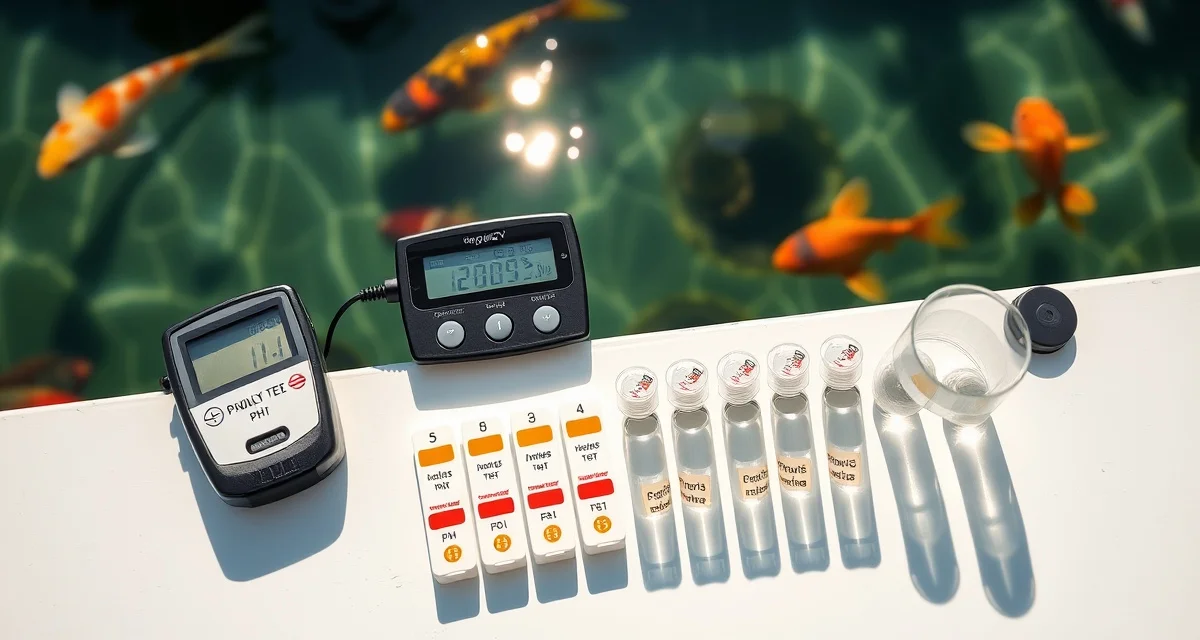
More accurate than test strips for most parameters. API Master Test Kit covers ammonia, nitrite, nitrate, and pH. Use separate tests for KH, GH, and DO.
Test Strips
Convenient for quick daily checks but less accurate, especially at low concentrations. Use liquid tests to verify when strips show anything abnormal.
Digital Meters
For pH and temperature, a calibrated digital meter is the most accurate option. pH meters need regular calibration against reference solutions. Temperature probes with dataloggers are increasingly affordable and invaluable for catching temperature events overnight.
Refractometer
For salinity during salt treatments. More accurate than salt test strips.
How to Interpret Results
Context Is Everything
Trend-based interpretation explains what your test results mean in the context of your pond's specific history. KoiQuanta's water quality tracker transforms each test into part of a trend that predicts problems early.
A single reading tells you the current state. The trend tells you the story:
- Ammonia rising slowly over 3 weeks → filter may be under stress
- Ammonia spiking and falling → overfeeding pattern
- pH dropping week over week → KH is depleting; need to buffer
- Nitrate rising faster than expected → water changes insufficient for stocking level
Seasonal Interpretation
Water temperature affects how you interpret parameters. Ammonia is more toxic in warm water than cold water at the same ppm reading. Dissolved oxygen is harder to maintain in warm water: the same DO reading that's safe in winter may be marginal in summer.
Common Testing Mistakes
Testing at the wrong time. Ammonia and pH both fluctuate over the day. pH is typically lowest in the morning and highest in the afternoon due to plant/algae photosynthesis. Test at the same time each day for accurate trend comparisons.
Shaking the reagent bottle before adding. For some liquid test kits, shaking bottle #2 before adding it to the sample is specified; for others it's not. Follow the kit instructions precisely: it affects colour development.
Not logging the result. A test you don't record might as well not have happened for trend analysis purposes.
What water tests should I do for my koi pond?
At minimum: ammonia, nitrite, pH, KH, and temperature. These five parameters together cover the most common causes of koi health problems. Add nitrate, GH, and dissolved oxygen for a complete picture. During cycling, new pond setup, illness, or after treatment, test ammonia and nitrite daily until levels stabilise at zero. KoiQuanta's water quality tracker logs all parameters and generates trend charts automatically.
How often should I test koi pond water?
Weekly testing of ammonia, nitrite, and pH should be the baseline for any active koi pond. Increase to daily during the first 6–8 weeks of a new pond, during any illness, or after any notable change (new fish, large water change, treatment). Reduce to fortnightly only for established ponds with no new fish introductions and stable parameters. Tracking ammonia in your ammonia tracking log over time is the most valuable single habit in koi keeping.
What do I do if my ammonia is high in my koi pond?
Stop feeding immediately: every meal adds more ammonia to the pond. Perform a 25–30% water change with treated water to dilute the ammonia. Check your filter is running properly and hasn't been disrupted. Add a commercial ammonia detoxifier (Prime or similar) to convert ammonia to less toxic ammonium while the filter catches up. Increase aeration. Retest every 24 hours until ammonia reaches zero. If ammonia continues to rise despite these steps, your filter may be undersized for your stocking level or may have crashed.
Related Articles
FAQ
What is How to Test Koi Pond Water: Parameters, Frequency, and What Results Mean?
Testing koi pond water means measuring key chemical parameters—ammonia, nitrite, nitrate, pH, and KH—to ensure your pond environment is safe for fish. This guide walks through which parameters matter most, what equipment to use, how often to test, and how to interpret your results over time. Single readings can be misleading; tracking trends is what tells you whether a spike is a temporary blip or a sign of a failing nitrogen cycle.
How much does How to Test Koi Pond Water: Parameters, Frequency, and What Results Mean cost?
Water testing itself is low-cost. Basic liquid test kits run $20–$50 and cover the essential parameters. Digital meters for pH and ammonia cost $30–$150 depending on quality. Ongoing costs are minimal—reagent refills for liquid kits. The real cost of not testing is far higher: treating sick koi, replacing fish lost to ammonia spikes or pH crashes, and emergency interventions that could have been avoided with routine monitoring.
How does How to Test Koi Pond Water: Parameters, Frequency, and What Results Mean work?
You collect a small water sample from your pond—ideally mid-water, away from returns or surface—then apply liquid reagents or dip test strips and compare the resulting color to a chart. Digital meters give direct numerical readings. Results are only useful in context: log each test with the date and conditions so you can spot trends. A single number means little; a rising ammonia reading over three days tells you the cycle is under stress.
What are the benefits of How to Test Koi Pond Water: Parameters, Frequency, and What Results Mean?
Regular water testing lets you catch problems before they become emergencies. Ammonia and nitrite spikes are invisible to the eye but deadly to koi within hours at high concentrations. Testing gives you early warning to act—perform a water change, reduce feeding, or add aeration—before fish show symptoms. It also helps you understand your pond's baseline so unusual readings stand out immediately, and it builds the trend data needed to make informed decisions.
Who needs How to Test Koi Pond Water: Parameters, Frequency, and What Results Mean?
Any koi pond owner should be testing water regularly, but it's especially critical for new pond keepers, anyone who has recently added fish, and hobbyists running heavily stocked ponds. New ponds cycling for the first time need daily testing for 6–8 weeks. Established ponds still need weekly checks. If you've treated for illness, done a large water change, or had a filter failure, daily testing is essential until parameters stabilize.
How long does How to Test Koi Pond Water: Parameters, Frequency, and What Results Mean take?
A routine water test takes 5–10 minutes using a liquid test kit. You'll need time to collect the sample, apply reagents, wait for color development (usually 5 minutes per test), and log your results. Digital meters are faster—under a minute per reading once calibrated. Weekly testing across all core parameters adds up to roughly 30 minutes. The time investment is small relative to the value of catching a water quality problem early.
What should I look for when choosing How to Test Koi Pond Water: Parameters, Frequency, and What Results Mean?
Look for a test method that covers all five core parameters: ammonia, nitrite, nitrate, pH, and KH. Liquid test kits are more accurate than strips. For pH, a digital meter with automatic temperature compensation is worth the upgrade. Choose reagents with a clear expiry date and replace them annually—old reagents give false readings. If you run a heavily stocked or large pond, consider a multiparameter digital meter for faster routine checks.
Is How to Test Koi Pond Water: Parameters, Frequency, and What Results Mean worth it?
Yes. Water quality failure is the leading cause of koi death, and most problems are invisible until fish are already in distress. Regular testing is the only way to know what's actually happening in your pond. The cost and time are minimal compared to the investment koi represent—both financially and emotionally. Hobbyists who test consistently and track trends over time lose fewer fish, spend less on treatments, and develop a much deeper understanding of how their pond operates.
Sources
- Associated Koi Clubs of America (AKCA)
- Koi Organisation International (KOI)
- University of Florida IFAS Extension Aquaculture Program
- Fish Vet Group
- Water Quality Association
Log Every Test, See Every Trend
Start tracking your water quality in KoiQuanta today. The koi pond water quality tracker turns every test into a data point in a trend chart that tells you where your pond is heading before you have a problem.